Bag Leather Sample Approval Checklist for Manufacturers

Approving a synthetic leather sample for bag production should involve more than checking color and surface grain.
A material may look correct as a small swatch but still create problems during cutting, sewing, folding, edge painting or final assembly.
For manufacturers, a structured sample approval process helps identify these issues before bulk material enters production.
The goal is simple:
Confirm that the material matches the specification and works with the actual bag construction.
Confirm the Basic Material Specification
Start by checking whether the sample matches the agreed material specification.
Do not rely only on the supplier label.
Verify:
| Item | What to Check |
|---|---|
| Material type | PVC, PU or other synthetic leather |
| Color | Matches approved reference |
| Grain | Correct embossing and texture |
| Surface finish | Matte, semi-gloss, high-gloss, printed or special finish |
| Thickness | Within required range |
| Width | Suitable for cutting plan |
| Backing | Correct fabric type and construction |
| Hand feel | Soft, medium or structured as required |
| Stretch | Appropriate amount and direction |
| Surface consistency | No obvious uneven color or grain variation |
Thickness should be checked at several positions because one measurement does not always represent the entire sheet.
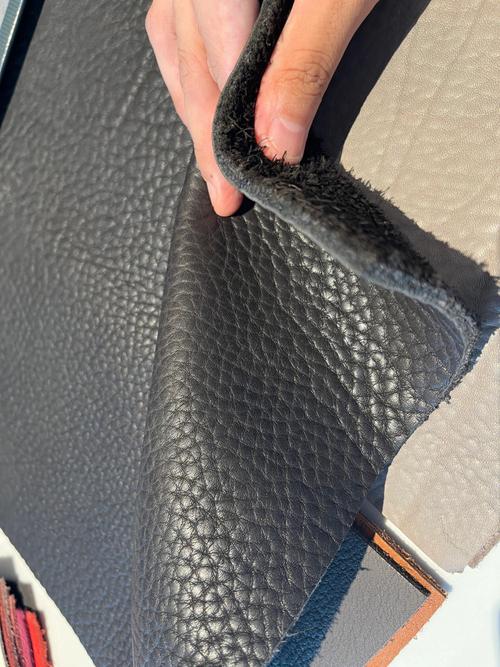
The reverse side should also be inspected carefully.
Backing construction can change flexibility, stretch, folding and sewing behavior even when the surface looks identical.
For more detail, see How Backing Fabric Changes PVC Leather for Bags.
Check Cutting, Sewing and Folding Behavior
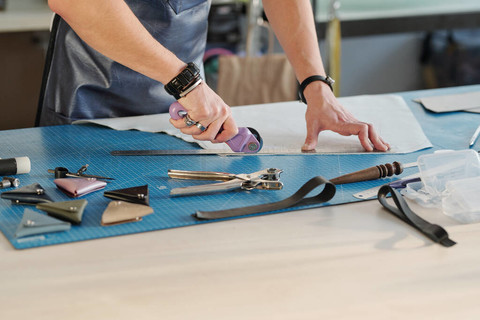
After confirming the basic specification, test the material using actual production processes.
Cutting
Check whether the synthetic leather:
- Cuts cleanly
- Stays dimensionally stable
- Curls excessively at the edge
- Stretches during cutting
- Produces excessive backing fibers
Long panels and straps are especially useful for detecting stretch or directional instability.
Sewing
Use the intended sewing machine, needle and thread.
Check:
- Material feeding
- Stitch consistency
- Seam flatness
- Needle marking
- Stitch-hole enlargement
- Backing distortion
- Multilayer seam bulk
Pay particular attention to areas where several layers overlap.
A material that sews well as a single layer may behave differently around handles, gussets or reinforced corners.
Folding
Test the material around the actual bend radius expected in production.
Look for:
- Surface whitening
- Permanent crease marks
- Wrinkles
- Cracking
- Layer separation
- Poor recovery
If the bag contains tight corners or accordion gussets, reproduce these shapes during testing.
For more detail, see Why PVC Leather Wrinkles or Turns White When Folded.
Test Important Bag Components Separately
Different bag components place different demands on synthetic leather.
It is useful to make small component samples before producing a full prototype.
Main Body Panels
Check:
- Surface appearance
- Shape retention
- Reinforcement compatibility
- Large-panel stability
Gussets and Side Panels
Check:
- Curved sewing
- Folding
- Corner wrinkling
- Stretch during assembly
See How to Choose Leather for Bag Gussets and Side Panels.
Handles and Straps
Check:
- Stretch
- Stitch-hole behavior
- Reinforcement
- Hardware attachment
- Repeated bending
See How to Choose Leather for Bag Handles and Straps.
Painted Edges
Check:
- Cut-edge cleanliness
- Backing fibers
- Edge-paint adhesion
- Color coverage
- Flexibility after drying
See How to Choose Synthetic Leather for Edge Painting.
Testing individual components makes it easier to identify exactly where a material or construction needs adjustment.
Check the Complete Material Combination
Synthetic leather should not be approved in isolation.
The final bag may also include:
- Lining
- Reinforcement
- Foam
- Webbing
- Adhesive
- Thread
- Zippers
- Buckles
- Rings
- Rivets
- Edge paint
These materials affect the finished thickness and behavior of the bag.
For example, a PVC leather may feel flexible alone but become too stiff after reinforcement and lining are added.
A strap may appear thin enough until both edges are folded around internal webbing.
Edge paint may look correct on a flat test strip but crack once the finished handle is repeatedly bent.
Create a combined sample using the real materials whenever possible.
Check:
| Combination Check | Approval Question |
|---|---|
| Leather + lining | Is the total structure too thick or too soft? |
| Leather + reinforcement | Does the component retain the required shape? |
| Leather + hardware | Is the material crushed or distorted? |
| Leather + adhesive | Does the surface remain flat and stable? |
| Leather + edge paint | Is adhesion and bending performance acceptable? |
| Leather + thread | Are stitch appearance and tension suitable? |
For a broader material-matching guide, see How to Match Bag Leather with Lining, Hardware and Edge Paint.
Final Sample Approval Checklist
Before bulk production, record the approval result rather than relying on verbal confirmation.
A practical checklist can include:
| Approval Item | Status |
|---|---|
| Material type confirmed | Pass / Review |
| Color approved | Pass / Review |
| Grain approved | Pass / Review |
| Surface finish approved | Pass / Review |
| Thickness confirmed | Pass / Review |
| Width confirmed | Pass / Review |
| Backing confirmed | Pass / Review |
| Stretch acceptable | Pass / Review |
| Cutting behavior acceptable | Pass / Review |
| Sewing behavior acceptable | Pass / Review |
| Folding performance acceptable | Pass / Review |
| Surface whitening acceptable | Pass / Review |
| Gusset sample approved | Pass / Review |
| Handle / strap sample approved | Pass / Review |
| Edge-paint sample approved | Pass / Review |
| Hardware compatibility approved | Pass / Review |
| Lining compatibility approved | Pass / Review |
| Reinforcement structure approved | Pass / Review |
| Prototype approved | Pass / Review |
| Bulk specification recorded | Pass / Review |
If any important item remains under review, the material should not automatically move into bulk production.
The safest approval sequence is:
material swatch → processing test → component sample → complete prototype → written approval → bulk production
For manufacturers purchasing PVC leather for bags and luggage, this process helps reduce the risk of discovering material problems after production has already started.
Xiangze Leather supplies synthetic leather in different thicknesses, surface grains and backing constructions for handbags, backpacks, luggage and fashion accessories. Samples can be evaluated according to the buyer’s intended sewing, reinforcement and finishing process before bulk specifications are confirmed.