How to Choose Synthetic Leather for Edge Painting

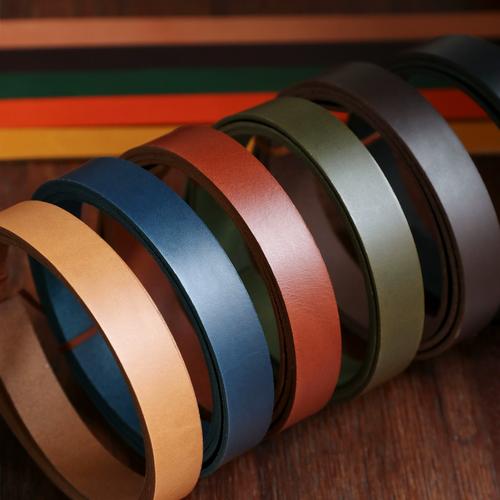
Edge painting is commonly used on handbag handles, straps, flaps, panels and small leather goods to create a clean and controlled finished edge.
However, not every synthetic leather produces the same result.
Two materials can look almost identical on the surface but behave very differently after cutting. One may produce a compact, smooth edge that is easy to finish, while another exposes loose backing fibers or several uneven layers.
For bag production, synthetic leather for edge painting should therefore be selected according to its cut-edge structure, backing, thickness, flexibility and compatibility with the intended edge-finishing system.
Check the Cut Edge Before the Surface
When selecting material for edge painting, start by cutting the synthetic leather.
The edge reveals information that cannot be seen from the grain surface.
Check whether the cut edge is:
- Clean and compact
- Uneven or porous
- Heavily fibrous
- Easy to compress
- Separating between layers
- Consistent along the length of the cut
A relatively clean and stable edge usually requires less correction before painting.
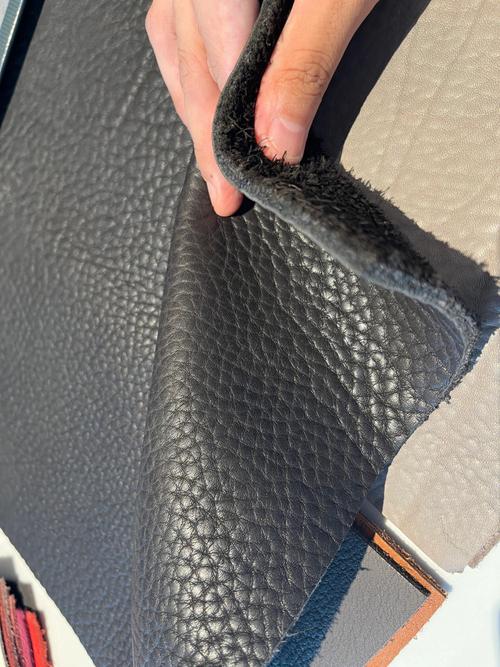
A very fuzzy backing can create a rough edge because textile fibers extend beyond the coating layer.
This does not automatically mean the material cannot be edge painted, but additional preparation or an appropriate filler system may be required.
The most important point is:
Good surface appearance does not guarantee a good painted edge.
Always inspect the cross-section of the actual material.
Backing Fabric Changes Edge Quality
Synthetic leather normally combines a surface layer with a supporting textile structure.
When the material is cut, both layers become part of the visible edge.
Different backing constructions can therefore produce different edge characteristics.
| Backing Characteristic | Possible Effect on Edge Painting |
|---|---|
| Compact textile structure | Cleaner cut edge |
| Loose or highly raised fibers | More visible fuzz after cutting |
| Thick backing | Greater edge thickness |
| Highly flexible backing | More movement during finishing |
| Stable backing | Easier dimensional control |
| Uneven backing surface | May require more edge preparation |
Brushed, knitted, woven and other backing constructions should not be judged only by their names.
Fabric density, thickness and surface treatment can make two backings within the same category behave differently.
This is one reason why backing selection is important for bag handles, straps and exposed-edge components.
For more background, see How Backing Fabric Changes PVC Leather for Bags and PVC & Synthetic Leather Backing Fabrics: Types, Structures and Applications.
Thickness and Layering Affect the Finished Edge
Edge painting becomes more complicated when several material layers are combined.
A single piece of synthetic leather may produce a relatively simple edge.
A handbag handle may contain:
synthetic leather + reinforcement + synthetic leather
A strap or structured panel may include:
surface material + reinforcement + lining + adhesive
All of these layers appear at the finished edge.
The result may become:
- Thicker
- More porous
- Less uniform
- More difficult to round
- More difficult to cover evenly
For this reason, material thickness should not be evaluated only as a single sheet.
The complete edge construction should be tested.
A thicker material can create an attractive substantial edge, but excessive thickness can make curves, corners and small components difficult to finish.
Thin materials can create a cleaner low-profile edge but may expose reinforcement more clearly if the layers are not aligned properly.
The target should be a consistent cross-section, not simply the thickest possible material.
Flexibility and Adhesion Must Work Together
A painted edge forms a coating over a part of the bag that may repeatedly bend.
This is especially important on:
- Handles
- Shoulder straps
- Flaps
- Wallet folds
- Small tabs
- Strap ends
- Curved bag panels
The edge finish therefore needs to remain attached while the underlying synthetic leather moves.
If the material bends significantly but the finished edge is too rigid, cracking can appear.
If adhesion between the edge coating and the material is poor, peeling or lifting may occur.
Before production, test the actual combination of:
synthetic leather + preparation method + filler/primer if used + edge paint + finishing process
Do not assume that an edge-paint system that works on one synthetic leather will behave identically on another.
PVC surface formulation, backing construction, exposed textile fibers and the complete laminated structure can all influence the result.
Processing conditions also matter.
Excessive sanding, heat or aggressive preparation can damage some synthetic leather constructions, so the finishing process should be matched to the specific material and edge-paint system.
Make an Edge Sample Before Bulk Production
The best way to approve synthetic leather for edge painting is to make a representative production sample.
Do not test only a small straight strip.
Include the types of edges that will actually appear on the bag.
Test:
- Straight edges
- Curved edges
- Folded areas
- Multilayer sections
- Strap ends
- Handle attachment areas
- Small-radius corners
Use the real reinforcement, adhesive and edge-paint system planned for production.
After the edge is fully finished, check:
| Check | What to Look For |
|---|---|
| Edge smoothness | No excessive fibers, pits or irregular areas |
| Layer visibility | Layers should not separate visibly |
| Adhesion | Edge coating remains attached |
| Bending | No obvious cracking or peeling |
| Rubbing | Finish remains stable during handling |
| Color | Consistent coverage along the edge |
| Curves | No excessive buildup or exposed areas |
| Seam intersections | Edge remains controlled around thicker sections |
Handles and straps deserve particula