How to Choose Leather for Bag Handles and Straps

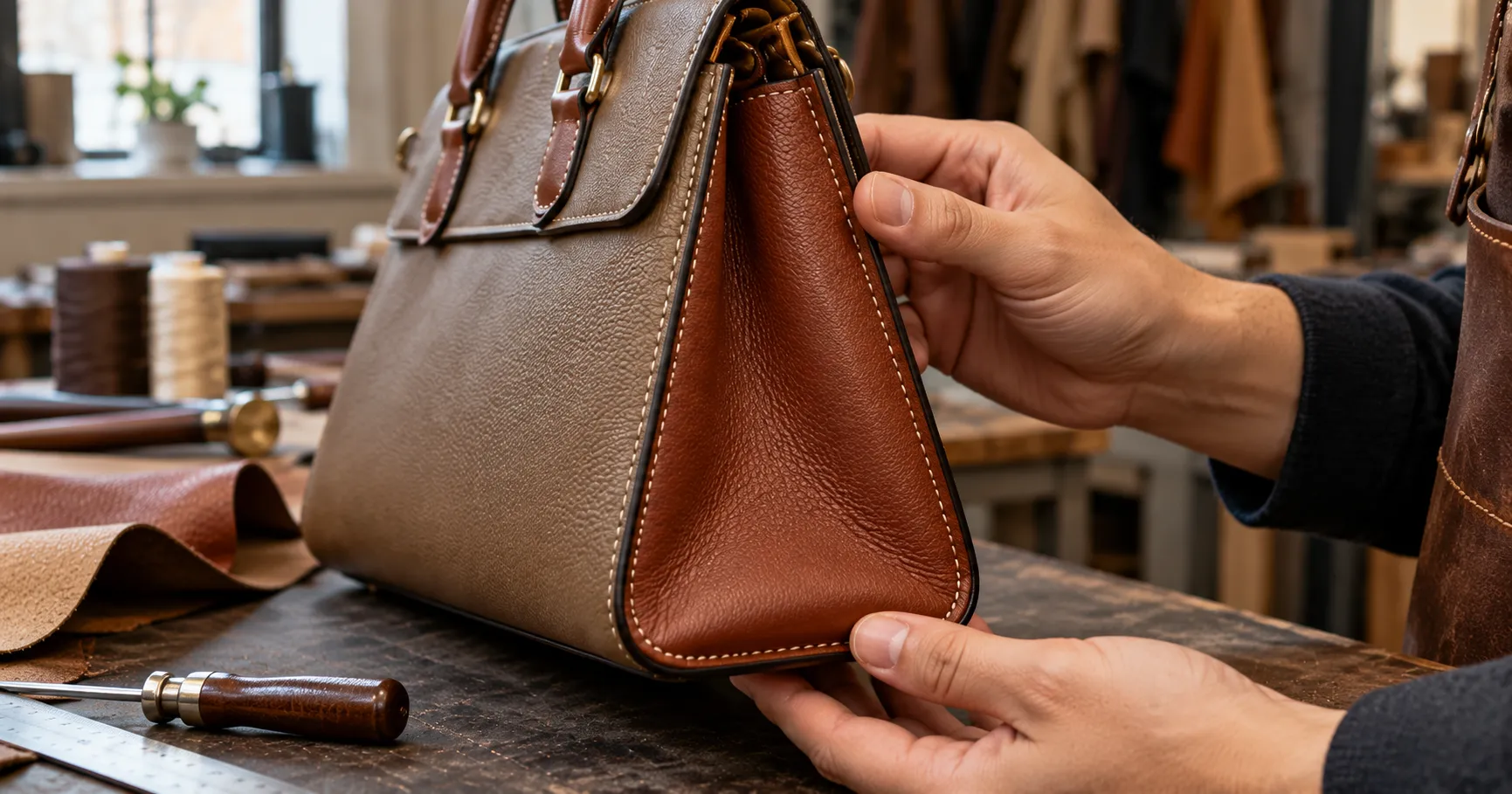
Bag handles and straps have different material requirements from most body panels.
A front or side panel mainly needs to maintain appearance and shape. A handle or shoulder strap must also withstand repeated pulling, bending, stitching and daily movement.
This means synthetic leather for handles and straps should be selected according to strength, stretch control, thickness, backing construction and reinforcement method, rather than surface grain alone.
Why Handles and Straps Need Different Material Behavior
Handles and straps repeatedly carry load through relatively narrow sections of material.
The stress is often concentrated around:
- Stitch lines
- Folded edges
- Handle attachment points
- Rivets and hardware
- Buckles
- Strap adjusters
- Reinforced ends
If the synthetic leather stretches too much, the strap may gradually become longer or lose its original shape.
If it is too stiff, folding and sewing can become difficult.
If the backing does not provide enough support, stitch holes or attachment points may become weak after repeated use.
A good strap material therefore needs a balance of:
flexibility + dimensional stability + tear resistance + suitable thickness
The exact balance depends on the bag design and internal reinforcement.
Control Stretch Through the Backing Construction
Backing fabric has a strong influence on how synthetic leather behaves under tension.
A flexible backing may be useful for curved or soft components, but excessive stretch is usually undesirable in a long shoulder strap.
For straps and handles, manufacturers should pay attention to:
- Stretch direction
- Amount of elongation
- Recovery after pulling
- Backing density
- Dimensional stability
- Behavior around stitch holes
A woven or relatively stable textile construction may provide better control for some strap designs.
Brushed or knitted constructions can also be used, but their actual stretch and density should be evaluated rather than judging them only by name.
This is particularly important when cutting long straps.
Even a small amount of stretch can become more noticeable across a long component.
For more information about backing structure, see How Backing Fabric Changes PVC Leather for Bags.
Thickness Must Be Checked After Folding
Handle and strap construction often multiplies the effective material thickness.
A simple strap may use:
PVC leather + reinforcement + lining
A folded strap may contain:
two folded leather edges + reinforcement + adhesive + stitching
The finished section can therefore become several times thicker than the original leather sheet.
| Construction | Main Consideration |
|---|---|
| Flat shoulder strap | Stretch control and dimensional stability |
| Folded strap | Seam bulk and edge folding |
| Rolled handle | Flexibility around a narrow radius |
| Padded handle | Leather must accommodate internal filling |
| Adjustable strap | Thickness must fit buckles and sliders |
| Reinforced handle end | Stitching and hardware create concentrated stress |
Using thicker synthetic leather does not automatically make a stronger handle.
If the folded construction becomes too bulky, sewing, edge finishing and hardware installation may become more difficult.
For more detail on this relationship, see How PVC Leather Thickness Affects Bag Sewing.
Reinforcement Often Matters More Than Leather Thickness Alone
Many bag handles and straps rely on internal reinforcement.
Depending on the construction, this may include:
- Woven tape
- Webbing
- Textile reinforcement
- Nonwoven reinforcement
- Synthetic reinforcement strips
- Foam
- Additional internal layers
The synthetic leather then provides the visible surface and part of the structural performance, while the internal reinforcement carries part of the load.
This is why simply increasing leather thickness is not always the best solution.
A relatively flexible synthetic leather combined with suitable reinforcement can sometimes create a stronger and cleaner strap than a very thick material used alone.
Reinforcement is especially important around attachment points.
Areas near rings, buckles and stitched handle ends experience concentrated stress. The reinforcement should extend far enough into the component to distribute the load rather than allowing all force to remain at one stitch