How to Test Synthetic Leather Before Footwear Production

How to Test Synthetic Leather Before Footwear ProductionHow to Test Synthetic Leather Before Footwear Production
A synthetic leather sample can look suitable on a swatch but behave differently once it enters footwear production.
Cutting, folding, stitching, bonding and shaping all place different demands on the material. For this reason, footwear manufacturers should evaluate more than color, grain and thickness before confirming material for bulk production.
A practical pre-production test helps determine whether the complete material construction is suitable for the intended shoe design and manufacturing process.
Start with the Material Specification
Before processing the material, check whether the sample matches the required basic specification.
Important points include:
| Check | What to Evaluate |
|---|---|
| Thickness | Actual thickness and consistency |
| Width | Whether it meets production requirements |
| Surface | Grain, color, gloss and finish |
| Backing | Fabric construction and appearance |
| Hand Feel | Softness, body and flexibility |
| Stretch | Amount and direction of movement |
Thickness should be measured rather than estimated by hand.
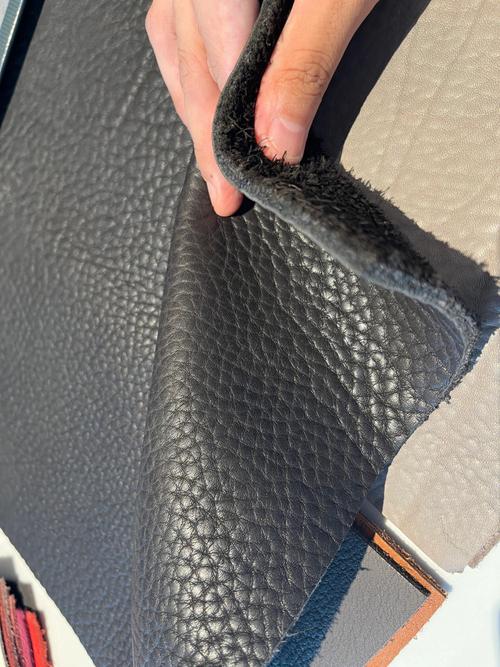
The backing should also be inspected because it contributes to flexibility, stretch and dimensional stability. Two synthetic leathers with similar surfaces and thicknesses may behave differently when their backing constructions are different.
For more detail, see How Backing Fabric Affects Synthetic Leather for Shoe Uppers.
Check Flexibility, Folding and Surface Behavior
Shoe uppers contain curved sections and areas that repeatedly bend during wear.
A simple initial evaluation is to bend and fold the material in directions similar to those expected in the finished shoe. Observe both the surface and the backing.
Look for changes such as unusual stiffness, visible surface stress, permanent creasing or other changes that could affect the appearance of the finished upper.
Thickness also influences this behavior. A thicker material may provide more body, while a thinner construction can generally be easier to fold and conform to curved areas.
However, thickness is only one factor. Coating construction and backing fabric should be evaluated together.
For a more detailed explanation, see How Synthetic Leather Thickness Affects Shoe Upper Flexibility and Sewing.
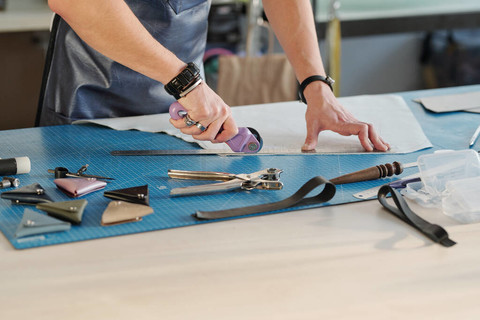
Test Cutting, Folding and Sewing
The next step is to process the material using conditions close to actual footwear production.
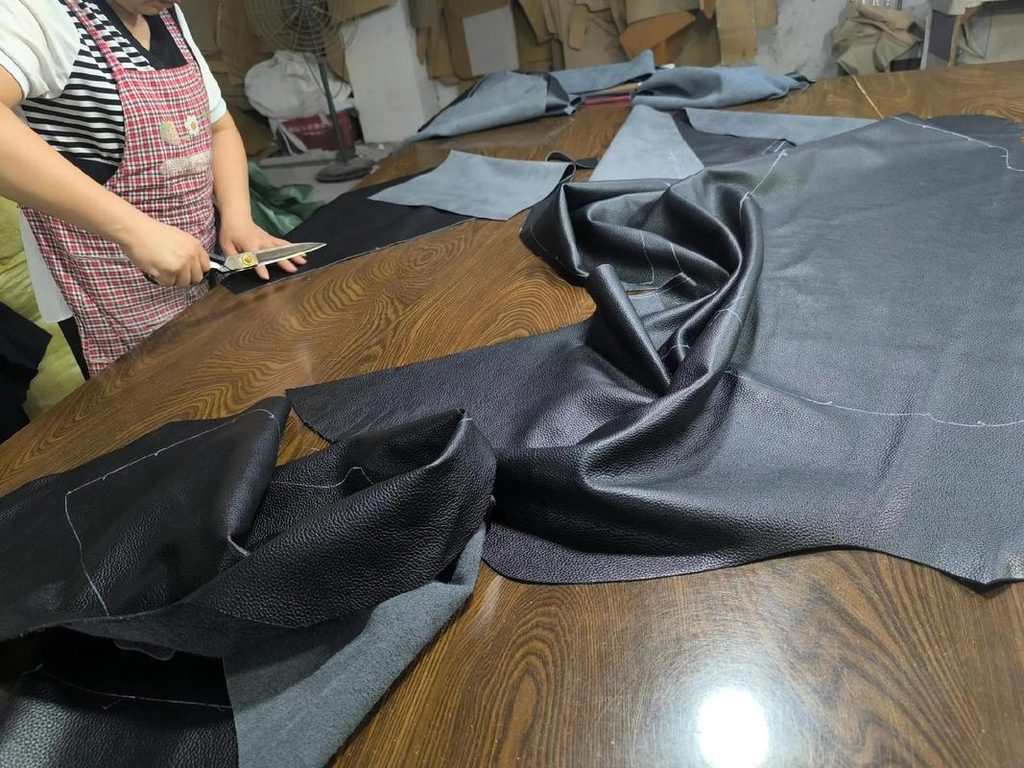
Cut several representative upper components rather than evaluating only a small rectangular swatch.
Check whether the material maintains its shape after cutting and whether the edges remain suitable for subsequent processing.
For designs requiring folded edges, test the actual fold width and construction planned for production.
Sewing trials are particularly useful. Evaluate how the material feeds through the machine, how the needle penetrates the layers, and how the finished seam looks.
Pay additional attention to areas where two or more layers overlap because the effective thickness at these points can be considerably greater than that of a single layer.
Evaluate Bonding and Shaping
Many footwear constructions require synthetic leather to be bonded to other materials.
Adhesive performance should therefore be evaluated using the actual adhesive, preparation method and production conditions whenever possible.
A small test can help identify whether the backing surface works well with the intended bonding process.
The material should also be evaluated during shaping or lasting.
A shoe upper is a three-dimensional structure, so material that behaves well as a flat sheet may respond differently when stretched or formed around curved areas.
Observe whether the upper conforms properly to the required shape and whether excessive stretching, wrinkling or surface changes occur during the process.
Make a Prototype Before Bulk Production
The most useful test is often a complete footwear prototype.
Laboratory measurements and material swatches provide valuable information, but a prototype combines the factors that actually occur during manufacturing.
The trial upper can be evaluated for:
- Cutting accuracy
- Folding behavior
- Stitch quality
- Bonding
- Shaping and lasting
- Surface appearance
- Flexibility
- Appearance after repeated movement
The evaluation criteria should be based on the intended footwear design and the buyer’s own production requirements.
For sandals, sneakers, casual shoes and other footwear constructions, the appropriate material specification can be different.
Testing a representative sample before confirming bulk production reduces the risk of discovering processing problems after large quantities of material have already entered production.
For additional options, explore our PVC Leather for Footwear & Garments range and compare different thicknesses, surfaces and backing constructions for your footwear project.