How to Choose Leather for Bag Gussets and Side Panels

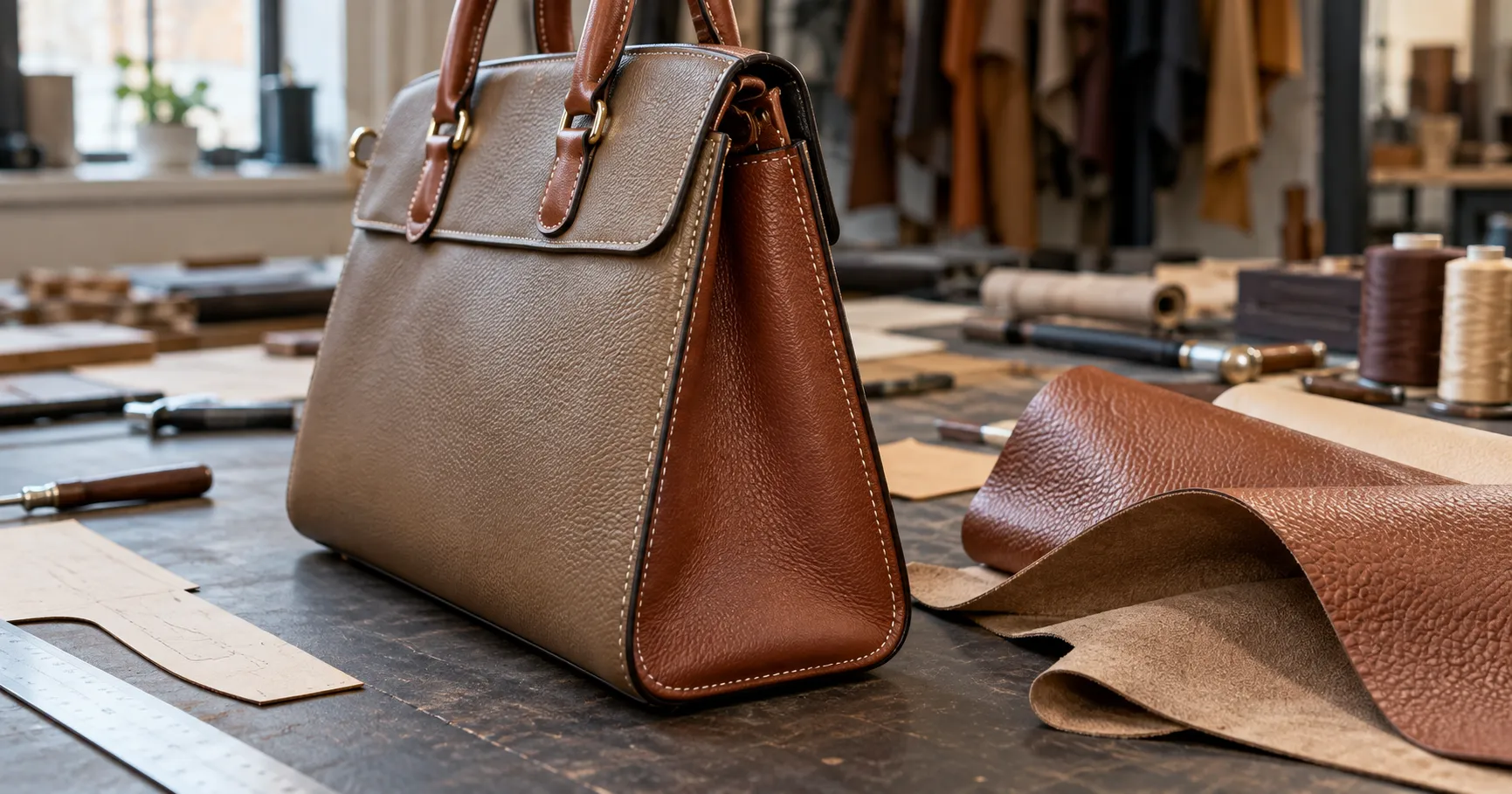
Bag gussets and side panels often need different material behavior from large front and back panels.
These areas bend around corners, connect several panels and frequently pass through curved sewing lines. If the synthetic leather is too stiff, too thick or poorly matched to the backing structure, the result can be difficult sewing, bulky seams or visible wrinkles.
For this reason, gusset material should be selected according to flexibility, thickness, backing construction and the shape of the finished bag, rather than only by surface appearance.
Why Gussets Need More Flexibility
A bag gusset forms the depth of the bag and usually connects the front and back panels.
Unlike a large flat panel, it may need to:
- Bend around bottom corners
- Follow curved sewing lines
- Fold inward when the bag closes
- Expand when the bag is filled
- Pass through several seam intersections
This creates more deformation than a flat body panel.
A relatively structured leather may work well on the front of a handbag but become difficult to handle when used around a tight side curve.
The tighter the gusset radius, the more important flexibility becomes.
However, the material should not be so soft that the side panel collapses or stretches excessively during sewing.
The goal is usually a balance between:
Flexibility + dimensional stability + sufficient body
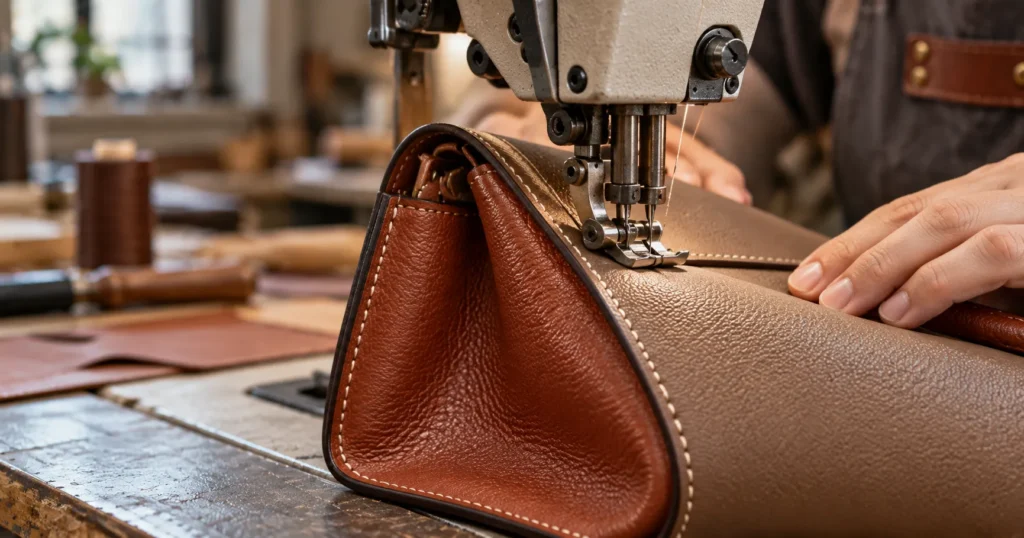
Choose Thickness According to the Fold and Seam
Thickness has a strong effect on gusset construction because side panels are often folded or joined with other components.
A single layer may appear thin enough, but the seam can contain:
gusset + body panel + lining + reinforcement + piping
At corners, these layers may overlap again.
This means a material that feels acceptable as a flat sheet can become bulky once sewn into the bag.
| Gusset Construction | Material Direction |
|---|---|
| Soft handbag side panel | Relatively flexible, lighter construction |
| Structured handbag gusset | Medium body with controlled stretch |
| Narrow gusset | Lower bulk is usually important |
| Wide expandable gusset | Flexibility and recovery become more important |
| Luggage side panel | More stability may be required |
| Folded gusset | Thickness must be checked after folding |
Very thick synthetic leather is not automatically stronger or better for gussets.
If the material creates excessive seam bulk, it may make turning corners difficult and reduce sewing consistency.
For more detail, see How PVC Leather Thickness Affects Bag Sewing.
Backing Fabric Changes Gusset Behavior
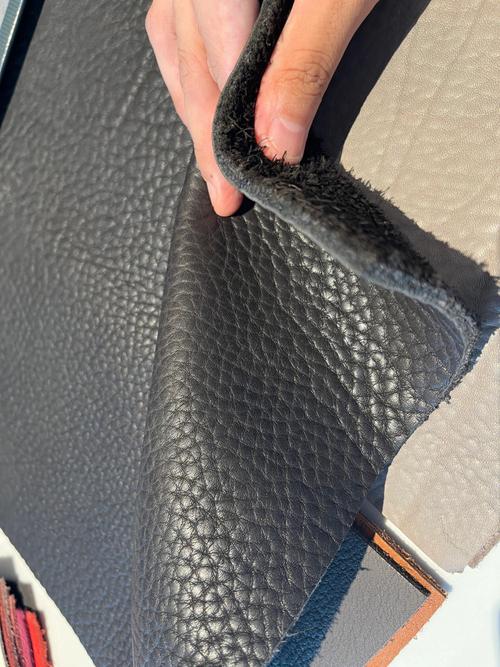
The backing fabric influences how the complete synthetic leather bends, stretches and recovers.
A flexible knitted or brushed backing can allow the gusset to follow curves more easily.
A more stable woven backing may provide better dimensional control when the side panel needs to hold its shape.
The important point is that backing should not be evaluated separately from thickness.
For example:
0.8 mm flexible backing may behave very differently from 0.8 mm stable woven backing.
The first may be easier around curves, while the second may provide a cleaner, more structured side wall.
Backing stretch direction also matters.
If the fabric stretches significantly along the sewing direction, the gusset can grow or distort during stitching.
For a broader explanation, see How Backing Fabric Changes PVC Leather for Bags.
Match the Material to the Gusset Design
Different gusset designs place different demands on the material.
Straight Side Panels
Straight side panels generally need less deformation.
A medium-body synthetic leather can often be used if the panel mainly connects the front and back sections without tight curves.
Curved Gussets
Curved gussets require easier bending and more controlled sewing.
A material that is too stiff may wrinkle around the curve or resist turning during assembly.
Accordion Gussets
Accordion or expandable gussets repeatedly fold inward and outward.
These designs usually need better flexibility and recovery because the material is not only sewn into shape but also moves during use.
Bottom-to-Side Continuous Gussets
Some bags use one long strip running from one side, across the bottom and up the other side.
This construction can create several tight curves and seam intersections.
The material should therefore be tested for:
- Corner bending
- Fold recovery
- Sewing stability
- Surface whitening
- Wrinkle formation
The same material may perform differently depending on the radius and reinforcement structure used in the pattern.
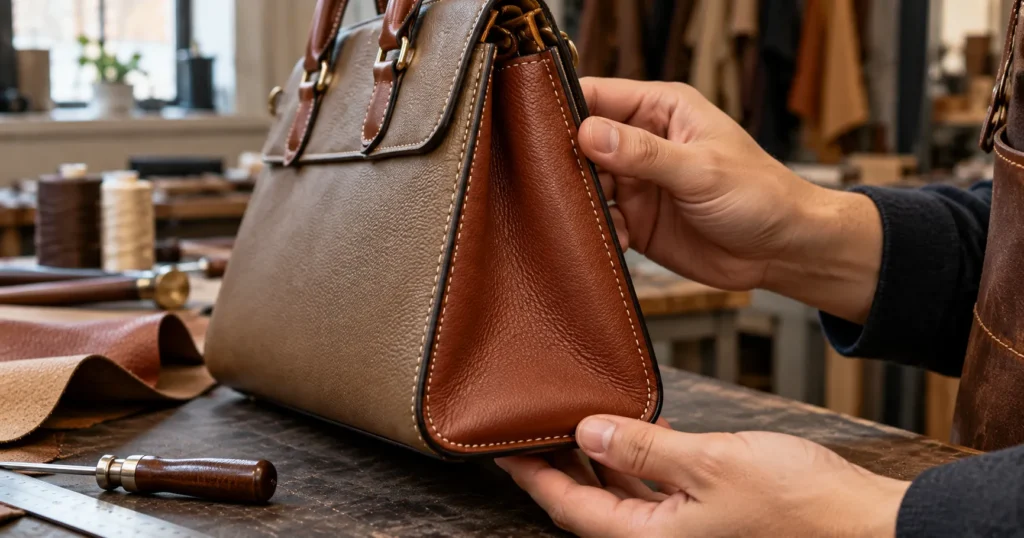
Test the Gusset Before Bulk Production
A flat swatch is not enough to approve material for side panels.
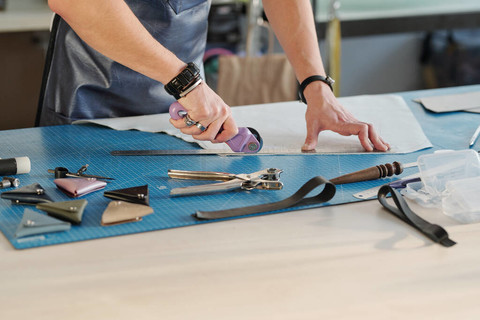
Make a representative gusset sample using the intended production method.
Use the actual:
- Body material
- Lining
- Reinforcement
- Piping
- Adhesive
- Thread
- Stitch length
- Corner radius
Then check:
- Whether the gusset feeds evenly during sewing
- Whether the curved seam stays smooth
- Whether corners develop wrinkles
- Whether the surface turns white when bent
- Whether folded areas become too bulky
- Whether the finished side panel keeps the intended shape
For expandable gussets, open and close the sample several times to see how the material recovers.
If the material wrinkles heavily, becomes permanently white or creates excessive seam bulk, possible solutions include reducing thickness, changing the backing, increasing the corner radius or modifying the reinforcement structure.
For a broader approval process, see How to Test Synthetic Leather Before Bag Production.
When selecting PVC leather for bags and luggage, gussets and side panels should be evaluated according to the complete bag construction rather than only surface appearance.
Xiangze Leather supplies synthetic leather in different thicknesses, backing constructions and surface grains for handbags, luggage, backpacks and other bag applications.