Industry Insights: Market Demand for PVC Leather in Furniture and Bags

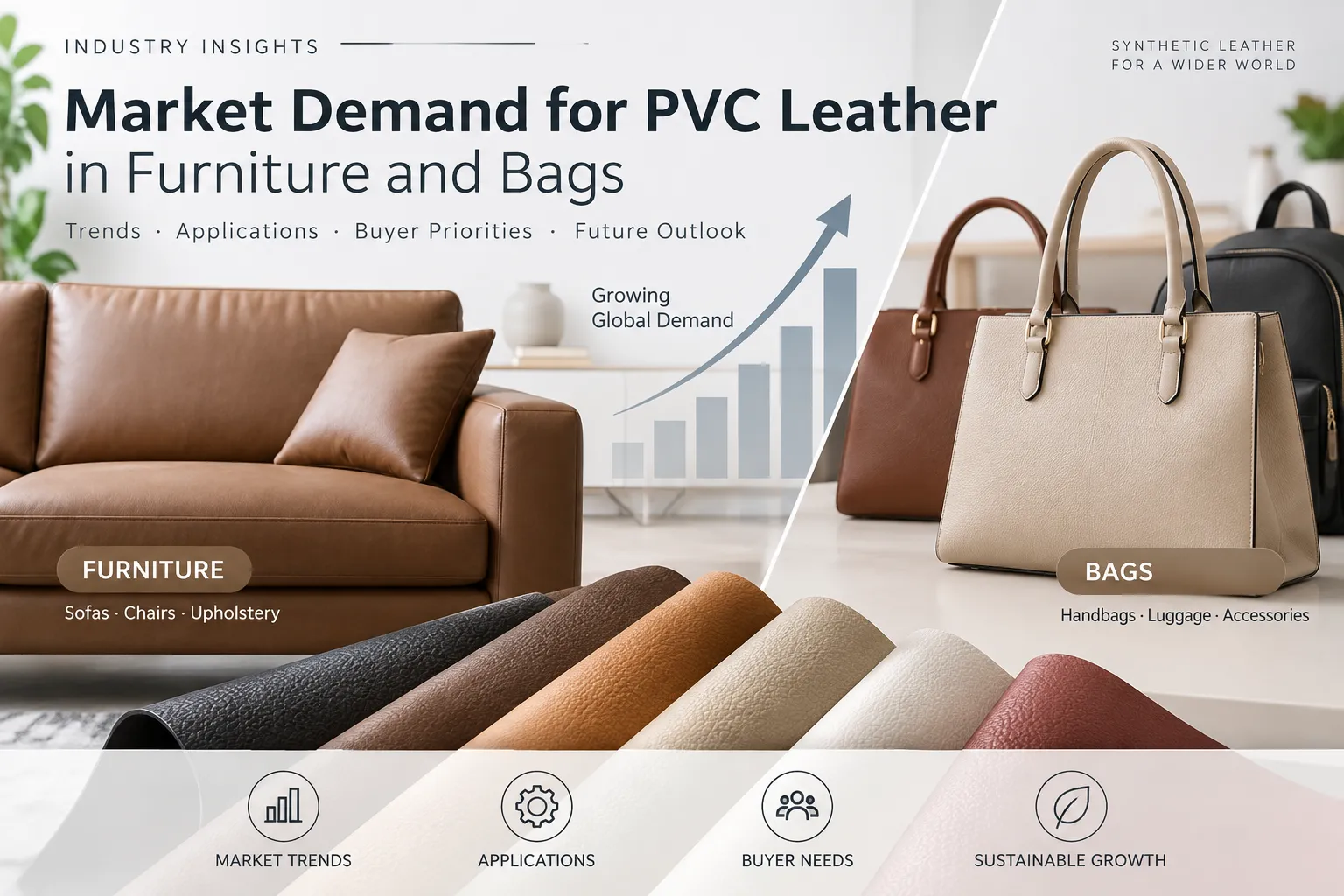
PVC leather continues to be used in furniture upholstery, bags, luggage and other manufactured products because it offers consistent surfaces, scalable production and broad options in color, grain and finish.
Current market reports consistently list furnishing and wallets, bags & purses among the major application segments for synthetic leather. Asia Pacific also remains the largest regional market in several 2026 industry reports, supported by its large furniture, footwear, bag and automotive manufacturing base.
Public forecasts differ significantly in total market size because research firms use different methodologies, so the more useful question for buyers is not the exact global number.
It is:
Where is demand coming from, and what are manufacturers now looking for when they source synthetic leather?
Furniture Demand Is Driven by Consistency and Production Efficiency
Furniture manufacturers usually need much more than a leather-like appearance.
For sofas, chairs and contract upholstery, the material must also work consistently across large production runs.
| Furniture Buyer Priority | Why It Matters |
|---|---|
| Color consistency | Multiple furniture units must match |
| Grain consistency | Helps maintain a uniform finished appearance |
| Roll width and usable area | Affects cutting efficiency |
| Surface cleanability | Important for residential and commercial seating |
| Abrasion performance | Relevant to repeated seating use |
| Stable repeat orders | Needed for long-running furniture collections |
| Cost control | Important for large-volume upholstery programs |
Synthetic leather remains attractive to furniture manufacturers because engineered surfaces can be reproduced more consistently than natural hides, while colors, grains and finishes can be standardized for mass production.
Current synthetic-leather market research continues to treat chairs, sofas and other furnishings as a distinct application segment.
For PVC specifically, demand remains strongest where buyers value:
repeatability + easy maintenance + surface variety + scalable cost
rather than the natural variation associated with genuine leather.
Bag and Luggage Demand Is More Design-Driven
The bag market creates a different type of demand.
Furniture buyers may use one grain and color for a large production program, while bag manufacturers often change textures, colors and surface effects more frequently.
Typical sourcing priorities include:
| Bag Buyer Priority | Typical Requirement |
|---|---|
| Grain | Fine grain, litchi, crocodile, stingray and others |
| Surface effect | Matte, high-gloss, metallic, printed or glitter |
| Color | Seasonal and custom color ranges |
| Thickness | Selected according to bag structure |
| Cutting | Stable surface and predictable processing |
| Repeatability | Important for repeat styles and reorders |
| Cost | Must fit the target retail segment |
Market research specifically separates wallets, bags and purses as a synthetic-leather application category. Grand View Research reports that the global synthetic-leather purse segment alone generated about USD 918 million in 2025 and projects a 10.7% CAGR through 2033.
That figure covers synthetic leather overall rather than PVC alone, but it shows that fashion accessories remain a meaningful growth application.
PVC leather can remain commercially attractive in bags where buyers want structured surfaces, embossed patterns, decorative finishes and repeatable mass production.
Demand Is Shifting From “Cheap Material” to “Fit for Use”
One important market change is that synthetic leather is no longer purchased only as a lower-cost substitute for genuine leather.
Recent industry reports increasingly describe demand around:
- consistent industrial production
- easier maintenance
- design flexibility
- application-specific performance
- environmental and regulatory requirements
- premium synthetic and bio-based alternatives
Fortune Business Insights estimates the global synthetic leather market at about USD 50.78 billion in 2026, while Grand View Research estimates roughly USD 50.6 billion for the same year. Both identify Asia Pacific as the largest regional market, although their growth forecasts differ.
At the same time, PVC does face stronger competition from PU and newer bio-based materials in applications where buyers prioritize softer hand feel, lower-emission systems or sustainability positioning.
That means PVC suppliers cannot compete only on low price.
The more sustainable commercial position is to match the material more precisely to the application.
For furniture, this may mean emphasizing:
cleanability · abrasion · consistency · repeat production
For bags:
grain · surface design · thickness · color · processing stability
What This Means for PVC Leather Buyers and Suppliers
The furniture and bag markets are both important, but they buy for different reasons.
| Market | Main Demand Driver | Supplier Should Focus On |
|---|---|---|
| Sofa Upholstery | Consistency and durability | Stable grain, color and production quality |
| Chairs / Contract Seating | Wear and cleanability | Surface performance and repeatability |
| Handbags | Design and appearance | Grain, color and surface effects |
| Backpacks | Processing and cost | Stable construction and scalable supply |
| Luggage | Appearance + structural use | Thickness, finish and production consistency |
| Fashion Accessories | Fast design changes | Flexible color and surface options |
For buyers, this means a supplier should not simply offer one generic “PVC leather.”
The material specification should reflect the finished product and production method.
For suppliers, the opportunity is also becoming more specialized:
furniture leather, bag leather, automotive leather and decorative leather increasingly need to be treated as different sourcing categories rather than one interchangeable material.
Xiangze supplies PVC leather for furniture upholstery and PVC leather for bags and luggage across different surface styles and specifications.
The broader market trend is clear:
Demand remains strong for synthetic leather, but future competition will depend increasingly on application fit, consistency and supply reliability rather than price alone.