Understanding UV Resistance in PVC Leather for Outdoor Applications

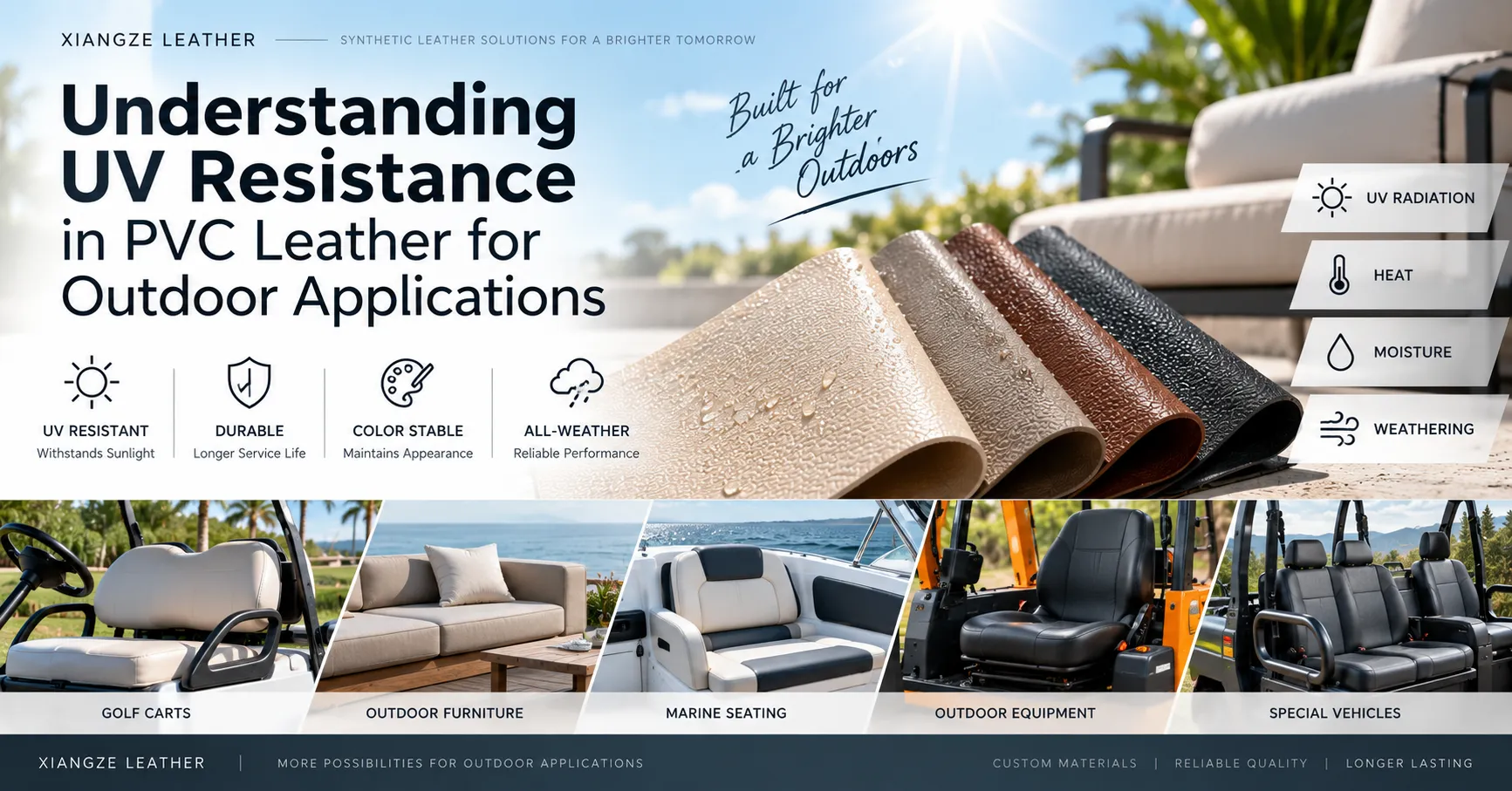
PVC leather used outdoors faces a very different environment from material used inside furniture, bags or enclosed vehicle interiors.
Direct sunlight brings UV radiation, heat and photo-oxidative aging, while rain, humidity and temperature changes can accelerate the overall weathering process.
For buyers, this means that a statement such as:
“UV resistant PVC leather”
is not enough on its own.
The useful information is:
how it was tested → under what exposure conditions → for how long → what changed after testing
What Does UV Resistance Actually Mean?
UV resistance describes the ability of a material to maintain acceptable appearance and performance after exposure to ultraviolet radiation and related weathering conditions.
Typical signs of outdoor aging include:
| Change After Exposure | What the Buyer May Notice |
|---|---|
| Color fading | Surface becomes lighter or uneven |
| Yellowing | Light colors shift in tone |
| Gloss change | Surface becomes unusually dull or shiny |
| Hardening | Material loses flexibility |
| Fine cracking | Small cracks appear during flexing |
| Coating degradation | Surface becomes easier to wear or peel |
| Strength loss | Aged material becomes more vulnerable mechanically |
UV exposure is rarely acting alone.
Outdoor materials may experience:
sunlight + surface heat + moisture + cooling + repeated flexing
during normal service.
This is why weather resistance is more useful than looking at UV exposure as an isolated property.
Which UV and Weathering Tests Are Relevant?
There is no single universal “UV test” for every PVC leather application.
Different standards reproduce different exposure conditions.
| Standard | Main Purpose | When It Is Useful |
|---|---|---|
| ISO 4892-2 | Xenon-arc exposure of plastics using light, moisture, temperature and humidity | General outdoor weathering evaluation |
| ASTM G155-25 | Operating xenon-arc apparatus for exposure to light, heat and optional moisture | Weathering programs for non-metallic materials |
| ISO 105-B04:2024 | Color fastness to artificial xenon weathering | Evaluating fading and color change |
| SAE J2412:2024 | Xenon-arc exposure for automotive interior trim | Enclosed automotive interior applications |
ISO 4892-2 specifies xenon-arc exposure in the presence of moisture to reproduce weathering effects caused by daylight, temperature, humidity and wetting. The 2013 edition remains current while a new edition is under development.
The current ASTM G155-25 similarly covers xenon-arc exposure using controlled light, heat and optional moisture, but ASTM specifically notes that the standard itself does not define one universal exposure condition or pass/fail result. It must be combined with an application-specific procedure and evaluation method.
For color change, ISO 105-B04:2024 focuses specifically on color fastness under artificial xenon weathering and can evaluate the combined effect of light and water.
For automotive interiors, SAE J2412:2024 is intended for controlled xenon-arc exposure of automotive interior trim. SAE also makes clear that test duration and performance criteria are defined by the individual automotive manufacturer’s material specification.
That distinction matters:
an open golf cart seat and an enclosed passenger-car seat may require different exposure conditions even if both use PVC leather.
Why “1,000 UV Hours” Is Not Enough Information
One of the most common sourcing mistakes is comparing materials only by the number of test hours.
For example:
Supplier A: 500 hours
Supplier B: 1,000 hours
Supplier C: 2,000 hours
This does not automatically mean Supplier C has the best material.
The result also depends on:
| Test Detail | Why It Matters |
|---|---|
| Light source | Determines the radiation spectrum |
| Optical filter | Direct daylight and window-filtered daylight are different |
| Irradiance | Controls exposure intensity |
| Temperature | Can accelerate degradation |
| Humidity / water spray | Changes weathering severity |
| Exposure cycle | Light/dark and wet/dry cycles matter |
| Evaluation method | Color, cracking and mechanical properties may all be assessed differently |
| Pass criteria | Defines what level of change is acceptable |
ASTM G155 explicitly warns that different operating conditions can produce different results and that exposure data should be reported together with the actual test conditions.
So instead of asking:
“How many UV hours does this leather pass?”
buyers should ask:
“Which standard was used, what were the exposure conditions, and what was evaluated after aging?”
A useful test report might include:
ISO 4892-2 → specified exposure cycle → X hours → color difference → surface cracking → gloss change → post-aging flexibility
That is much more meaningful than an isolated hour number.
Match the UV Requirement to the Actual Outdoor Application
Not every outdoor project needs the same level of weathering resistance.
| Application | Main Exposure | What Buyers Should Prioritize |
|---|---|---|
| Golf Cart / Sightseeing Vehicle | Direct sun, humidity, repeated use | UV weathering + abrasion + cleaning |
| Outdoor Equipment Seat | Sun, heat, rain, dirt | Weathering + flexing + coating durability |
| Marine / Coastal Seating | UV, moisture, high humidity | Weathering + mildew/moisture resistance |
| Outdoor Furniture | Long sunlight exposure | Color fastness + weathering + cleanability |
| Semi-Covered Vehicle | Intermittent direct sun | Moderate weathering + interior durability |
This is also why SAE J2412 should not automatically be treated as the only outdoor-vehicle UV standard. It is designed for automotive interior trim, while standards such as ISO 4892-2 and ASTM G155 are broader tools for reproducing daylight and moisture-related weathering.
For procurement, the better process is:
define the real exposure → choose the relevant test method → agree on exposure conditions → define acceptable changes → compare samples
Xiangze supplies PVC synthetic leather for automotive and other applications, including materials that can be evaluated according to project-specific outdoor requirements.
The key principle is:
UV resistance should be treated as a measurable weathering requirement, not simply as a product label.