What Makes a PVC Leather Suitable for Automotive Interiors? Essential Guide

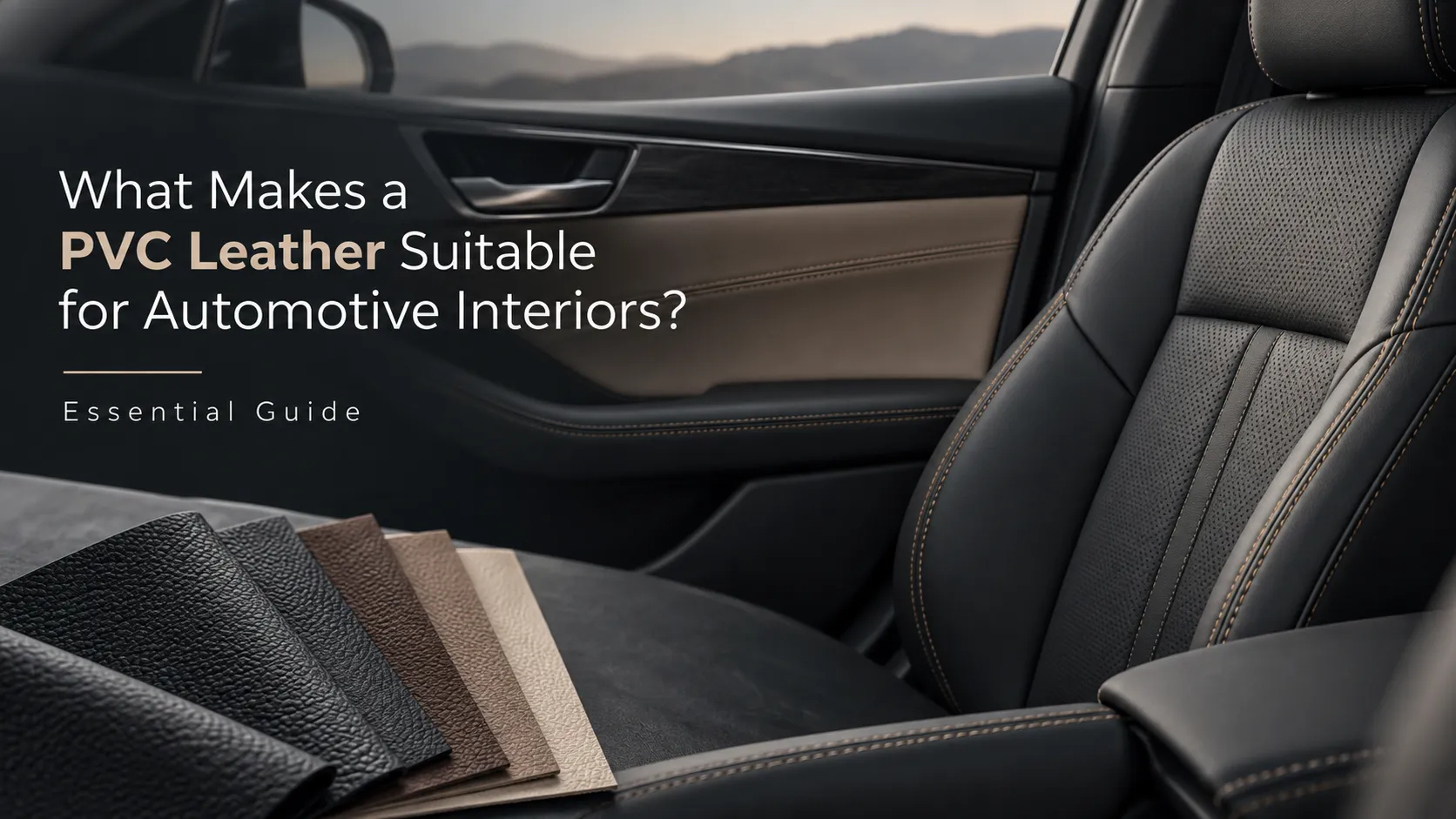
Automotive buyers rarely choose PVC leather based on material type alone.
Two PVC leather samples can have a similar grain and thickness but behave very differently during cutting, sewing, wrapping and long-term vehicle use.
For manufacturers sourcing automotive upholstery materials, the real question is not simply whether a supplier offers “automotive PVC leather.”
The important question is whether the material can match the component, processing method, required performance and production specification of the project.
Start With the Automotive Application
Different automotive components require different material characteristics.
| Application | What Buyers Usually Need to Confirm |
|---|---|
| Car Seats | Flexibility, abrasion, sewing and surface durability |
| Headrests | Conformability and appearance consistency |
| Armrests | Repeated contact and cleaning resistance |
| Door Panels | Forming behavior and surface appearance |
| Steering Wheel Trim | Stretch control and surface durability |
| Quilted Panels | Foam, stitching and finished appearance |
This means buyers should avoid sourcing one generic “automotive leather” for every interior component.
A better approach is to tell the PVC leather supplier where the material will be used first, then compare suitable samples.
For example:
“We need PVC leather for car seat side panels, approximately 0.8–1.0 mm, with a fine automotive grain.”
is much more useful than:
“Please quote automotive leather.”
Compare the Complete Specification, Not Only Price
When comparing several PVC leather suppliers, buyers often receive samples that look very similar.
The differences usually become clearer when the full specification is compared.
| Specification | Why Buyers Should Check It |
|---|---|
| Thickness | Affects handling and finished structure |
| Width | Affects cutting efficiency and material usage |
| Grain | Determines appearance and matching |
| Surface Finish | Matte, gloss, perforated and other options |
| Flexibility | Influences wrapping and sewing |
| Color | Must remain consistent between orders |
| Performance Requirements | Should match the target vehicle project |
This is where supplier capability becomes important.
A supplier should be able to explain what the material is designed for, not simply provide a model number and price.
For bulk sourcing, the approved sample should also become the reference for later production.
Ask for Samples and Relevant Test Data
A specification sheet is useful, but automotive materials should normally be evaluated physically before bulk ordering.
Buyers can compare:
surface appearance → flexibility → cutting → sewing → finished upholstery
Relevant testing can then be selected according to the actual project.
For example:
| Requirement | Possible Test |
|---|---|
| Surface Wear | Martindale / Taber abrasion |
| Coating Adhesion | ISO 2411 |
| Light Aging | SAE J2412 |
| Flexing | ISO 7854 |
| Cleaning | VDA 230-212 |
| Flammability | ISO 3795, where applicable |
The important point is not to request every possible automotive test.
Instead, buyers should ask the supplier:
Which tests are relevant to this particular component and project?
This produces a much more useful specification than simply requesting “automotive grade PVC leather.”
What Should You Send a PVC Leather Supplier?
A supplier can recommend materials much faster when the inquiry contains useful project information.
Instead of sending:
“Send me your PVC leather price.”
send something closer to:
| Information | Example |
|---|---|
| Application | Car seat upholstery |
| Material | PVC synthetic leather |
| Thickness | 0.8–1.0 mm |
| Color | Black / custom color |
| Grain | Fine automotive grain |
| Quantity | 5,000 meters |
| Performance | Abrasion + light aging required |
| Sample | Existing reference sample available |
This allows the supplier to narrow the product range before sending samples.
For buyers sourcing from China, this step is especially useful because it reduces repeated sample shipments and quotation revisions.
Xiangze’s Automotive & Motorcycle Leather range includes PVC synthetic leather for car seats and related vehicle interior applications, while the Automotive Interiors page provides an overview by application.