How PVC Leather Embossing Changes Surface Appearance

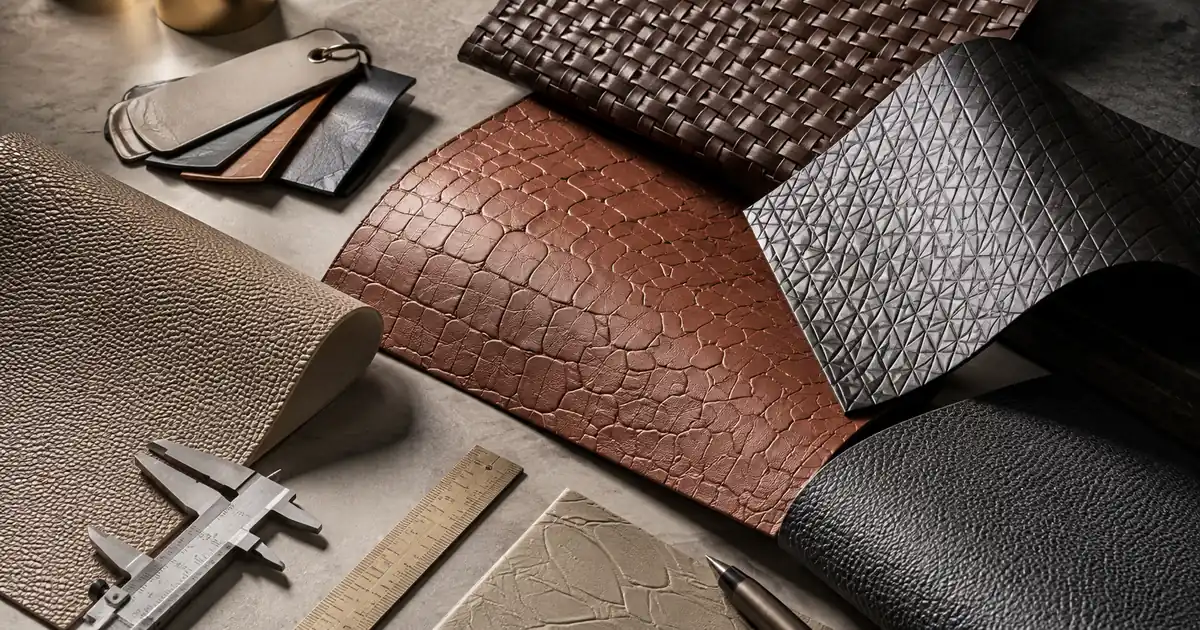
PVC leather embossing can transform a relatively simple surface into fine natural grain, basket weave, geometric texture, crocodile pattern or a highly decorative three-dimensional design.
The color of the material may remain the same, but changing the embossing pattern can make the finished PVC leather look significantly different.
A small fine grain can create a clean and understated surface. A deep basket weave can make the same color appear more structured and decorative. A geometric embossing may give the material a modern character, while an irregular natural grain can make the surface appear softer and less repetitive.
For B2B buyers, embossing is therefore more than a pattern name.
The final visual result depends on several factors working together:
- Pattern shape
- Grain scale
- Embossing depth
- Surface finish
- Color
- Material thickness
- Finished-product size
- How the material is bent, stretched or sewn
Xiangze Leather supplies PVC Leather Materials with a wide range of embossed surfaces for bags, luggage, upholstery, automotive interiors and decorative manufacturing.
Understanding how embossing changes appearance can help buyers select a surface that remains visually balanced after the material is converted into the finished product.
What Embossing Changes on the PVC Leather Surface
Embossing changes the physical relief of the PVC surface.
Instead of relying only on color, it creates raised and recessed areas that interact with both touch and light.
This can change how the material looks even when the base color remains identical.
From Flat Surface to Visible Texture
A relatively smooth PVC surface reflects light differently from an embossed surface.
Once a texture is added, light falls across raised and recessed areas at different angles.
This can produce:
- Stronger highlights
- Darker recessed areas
- More visible depth
- More complex shadows
- Greater surface variation
As a result, a single-color embossed material can look much richer than a flat surface of the same color.
Embossing Can Create Natural-Looking Grain
Some embossing patterns are designed to reproduce the visual character of natural leather.
Examples include:
- Fine grain
- Pebble grain
- Litchi grain
- Wrinkle grain
- Cowhide-inspired grain
These patterns generally use irregular surface structures rather than perfectly repeated geometric forms.
The objective is often to reduce the appearance of a completely uniform synthetic surface.
Embossing Can Also Be Deliberately Decorative
Not every embossed PVC leather is intended to imitate natural leather.
Decorative embossing can include:
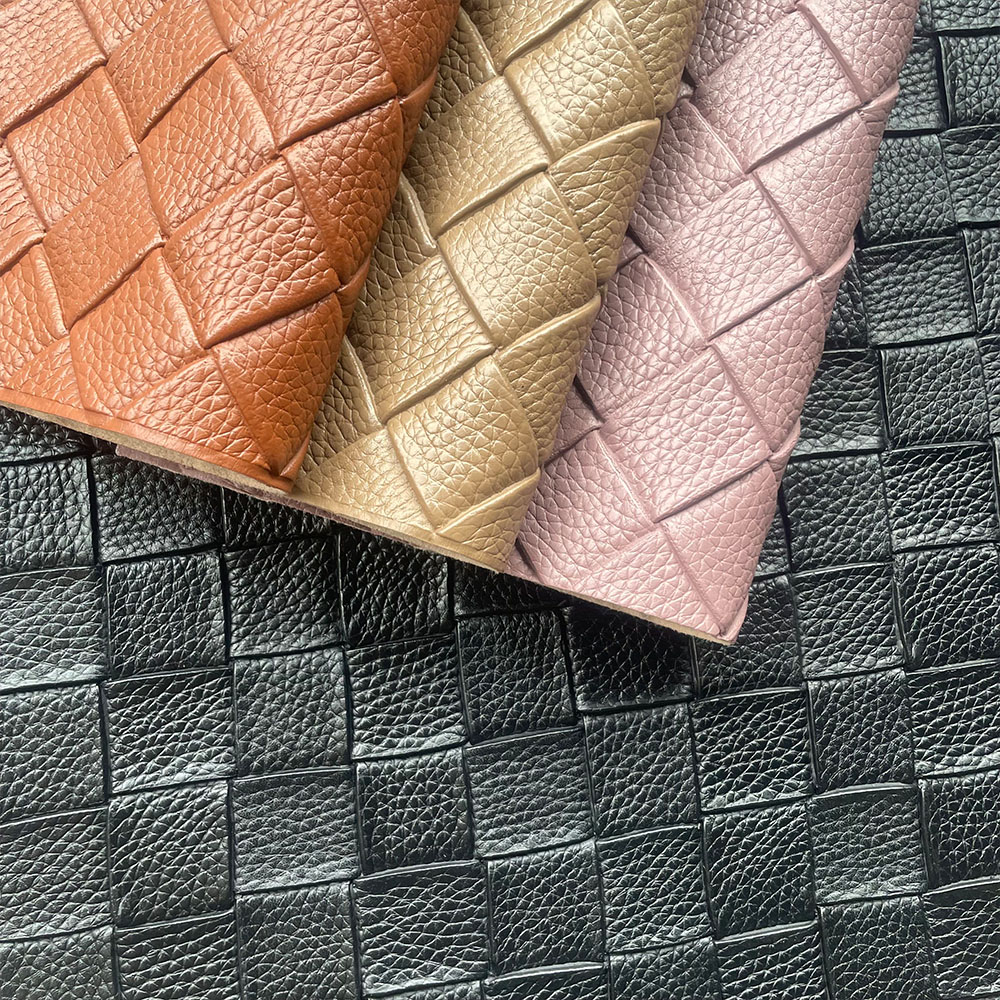
- Basket weave
- Woven texture
- Diamond pattern
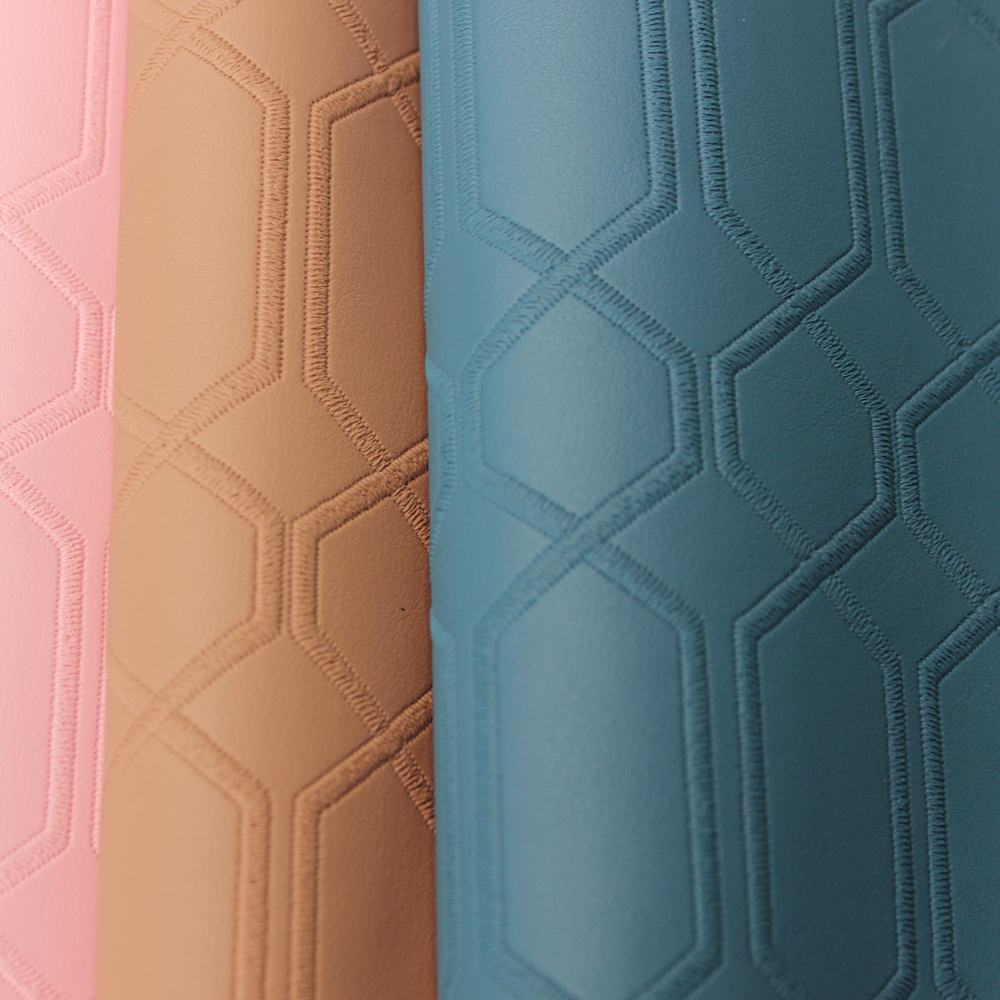
- Honeycomb pattern
- Hexagon pattern
- Geometric shapes
- Floral patterns
- Chain patterns
- Crocodile and other animal-inspired textures
These designs make the surface itself part of the product styling.
Xiangze Leather’s Embossed Leather for Bags category includes materials where dimensional texture is one of the main visual features.
The choice between natural-looking and decorative embossing depends on whether the finished product should look restrained, leather-like, structured or strongly fashion-oriented.
How Embossing Depth and Grain Scale Change Appearance
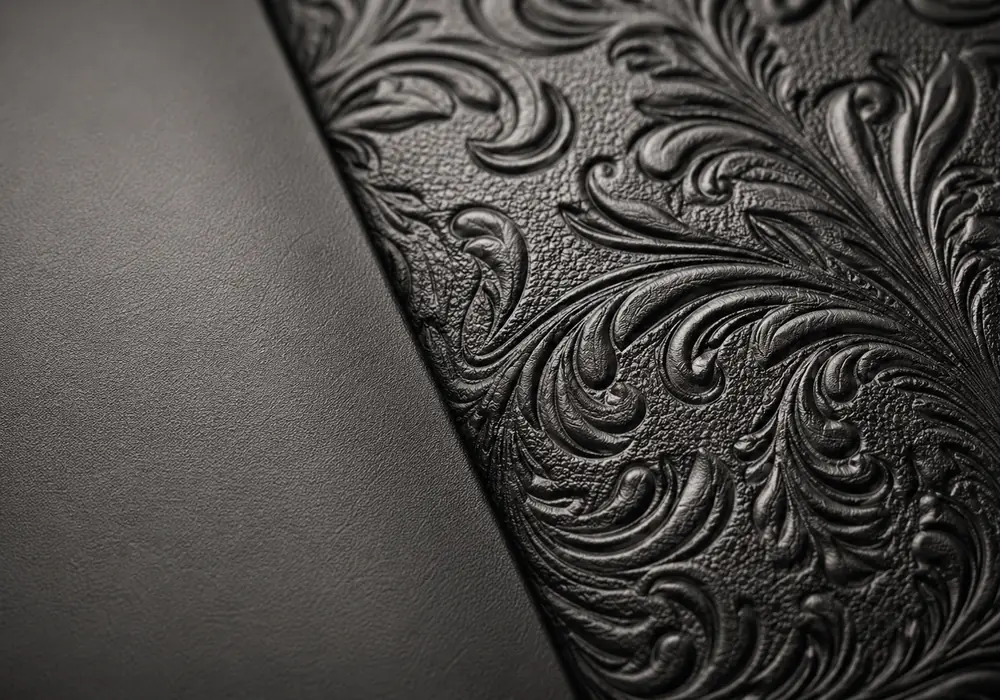
Two embossed materials can use similar pattern concepts and still look very different.
The two most important reasons are embossing depth and pattern scale.
Shallow Embossing Creates a More Subtle Surface
A shallow embossed pattern usually creates less contrast between the raised and recessed areas.
The surface can appear:
- Cleaner
- More refined
- Less visually dominant
- More uniform from a distance
Fine grains and micro textures often work this way.
They can be useful when the texture should support the design rather than become the main visual element.
Typical applications can include:
- Small handbags
- Wallets
- Shoe components
- Automotive trim
- Smaller fashion accessories
Deeper Embossing Produces More Visual Dimension
As embossing becomes deeper, the surface relief becomes more obvious.
The material may appear:
- More three-dimensional
- More structured
- More decorative
- More strongly textured
- More visible from a greater distance
Deep basket weave, large geometric patterns and strong animal-inspired embossing can produce this effect.
However, deeper does not automatically mean better.
The correct depth depends on the finished product and the desired design.
Small Grain and Large Grain Create Different Visual Scale
Grain scale refers to how large the individual pattern elements appear.
Consider two basket-weave materials.
One may contain many small woven elements within a 10 cm area.
Another may contain only a few large woven elements across the same area.
Even if both are described as Basket Weave Embossed PVC Leather, their appearance can be completely different.
Small-scale patterns generally appear:
- Finer
- More detailed
- More controlled
Large-scale patterns generally appear:
- Stronger
- More graphic
- More visible on large panels
Match Pattern Scale to Product Size
The size of the finished product matters.
A very large embossing pattern on a small wallet may show only part of the pattern and appear visually unbalanced.
A very fine texture on a large luggage panel may become almost invisible from normal viewing distance.
This is why buyers should evaluate embossing on a sample large enough to represent the actual product.
A useful rule is not simply:
small product = small grain
and:
large product = large grain
but rather:
evaluate how much of the pattern will actually appear on each finished component.
How Pattern Shape, Color and Surface Finish Work Together
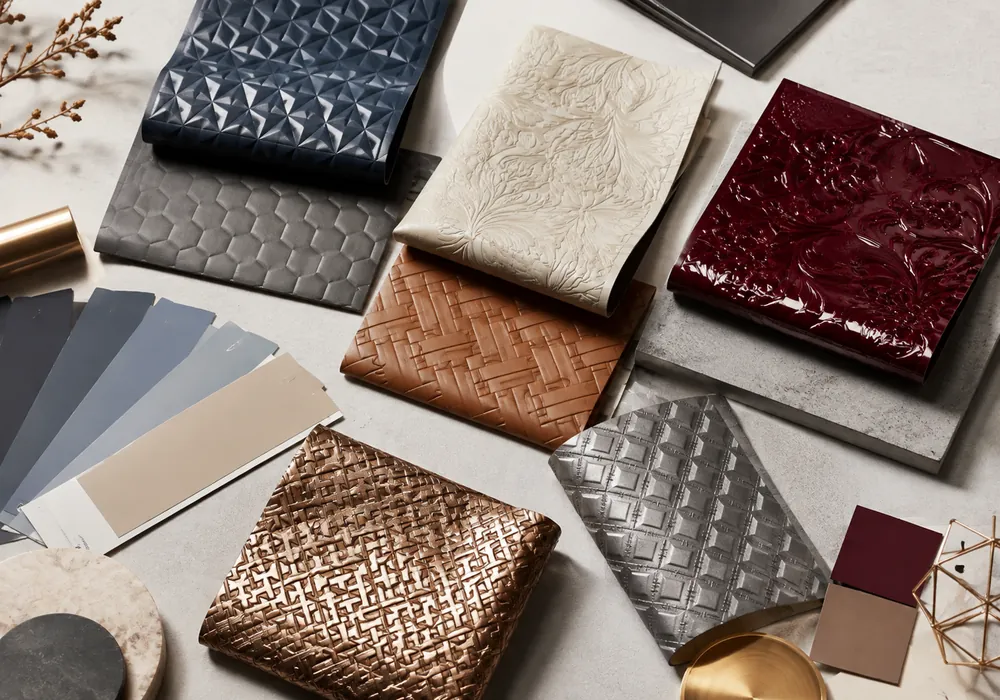
Embossing does not operate independently from the rest of the surface design.
The same embossing pattern can look dramatically different when color and Surface Finish change.
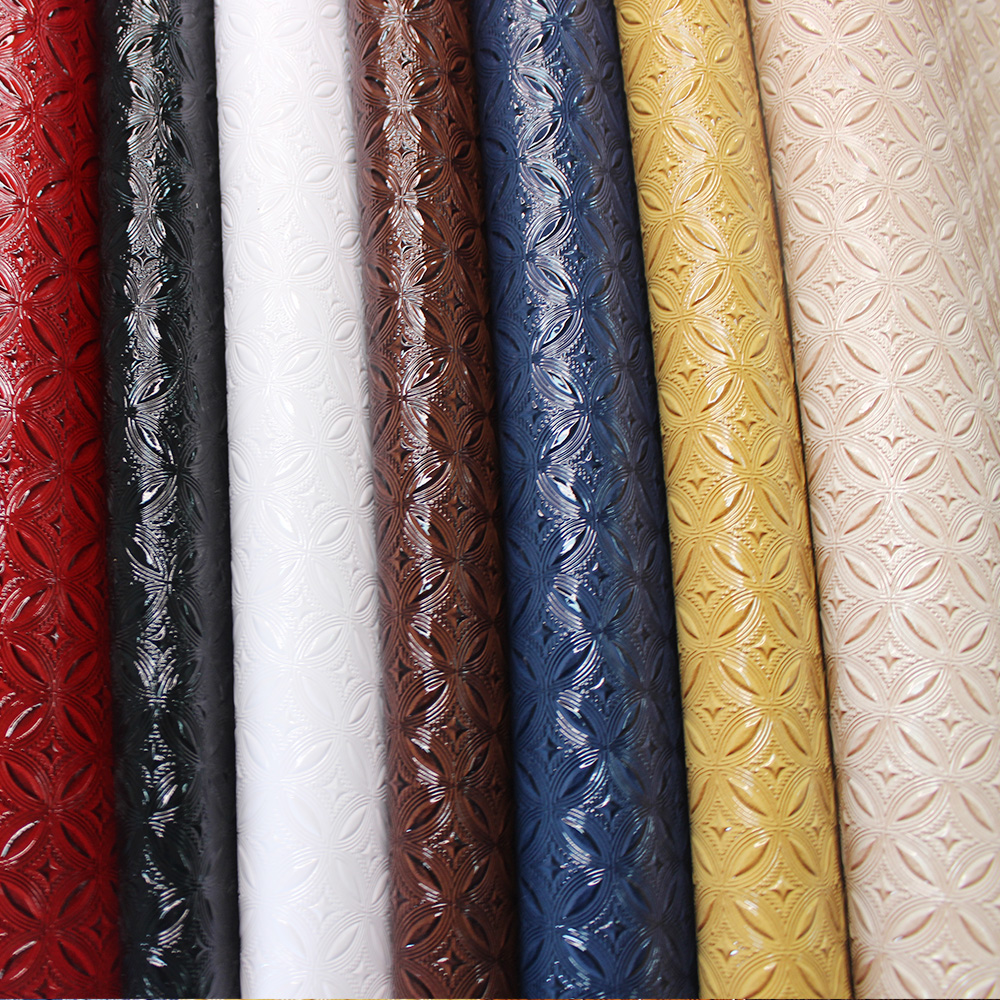
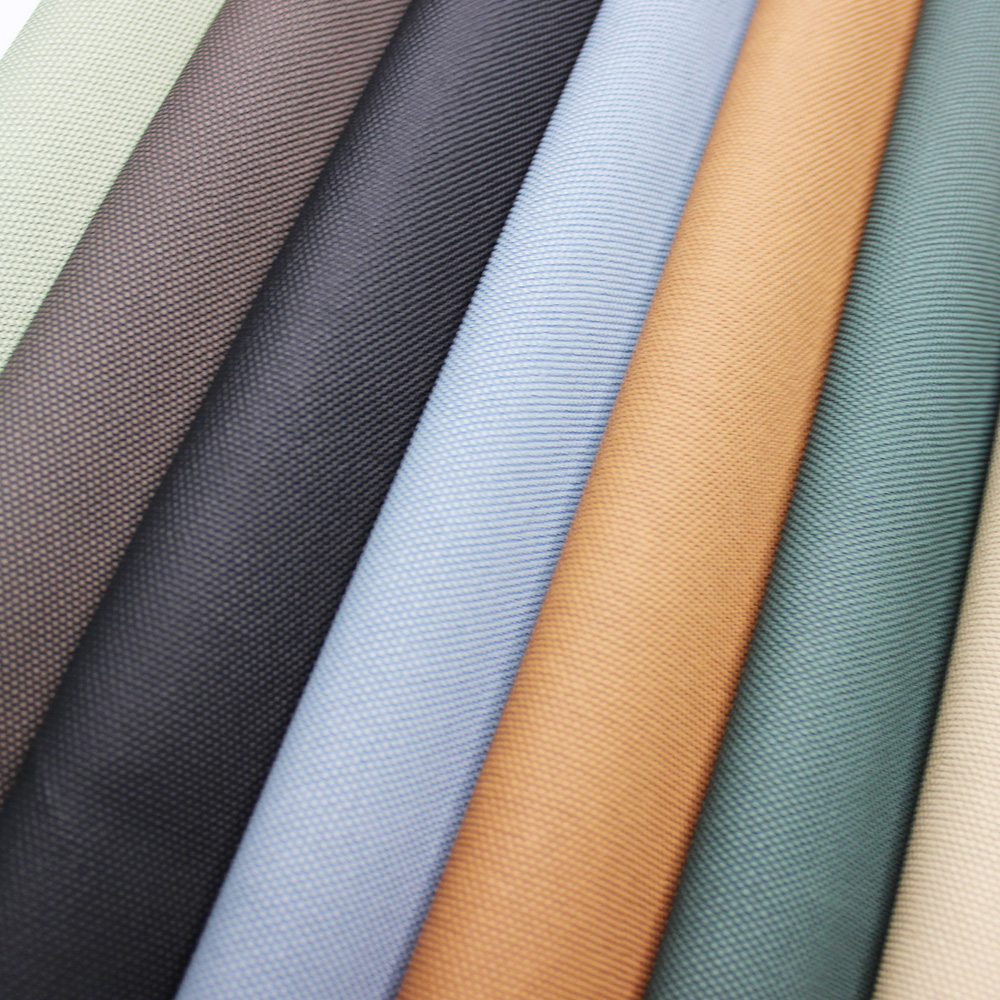
Geometric Patterns Create a More Structured Look
Patterns such as:
- Hexagons
- Diamonds
- Squares
- Cubes
- Repeating lines
usually create a more organized and engineered appearance.
They can make PVC leather look modern and strongly decorative.
Regular geometry is also more noticeable when used on large flat panels because the repetition is easy to see.
Irregular Patterns Look More Natural
Fine grain, pebble, wrinkle and other irregular structures usually have less obvious repetition.
This can make them appear more natural and visually softer.
For products intended to resemble traditional leather, irregular embossing is often easier to use than highly geometric surfaces.
Woven Patterns Create Visual Structure
Basket weave and woven embossing imitate interlaced strips or textile structures.
Depending on pattern scale, they can range from subtle woven grain to highly pronounced three-dimensional designs.
These surfaces are particularly useful for:
- Handbags
- Tote bags
- Wallets
- Luggage
- Fashion accessories
because the embossed pattern can become part of the product’s styling without requiring a printed graphic.
Matte Finish Makes Embossing More Restrained
A matte surface reflects less light.
This can reduce contrast across the embossed pattern and create a quieter appearance.
Fine grain combined with matte finish may therefore appear particularly understated.
Glossy Finish Can Emphasize Texture
Gloss increases light reflection.
Raised areas may catch stronger highlights while recessed areas remain darker.
This can make embossing appear:
- Deeper
- Sharper
- More decorative
- More visually prominent
A glossy geometric or crocodile embossed material may therefore have much stronger visual contrast than the same pattern with a matte finish.
Metallic Effects Can Further Increase Surface Dimension
Metallic finishes interact strongly with light.
When metallic color is combined with embossing, different parts of the pattern reflect light at different angles.
The surface can appear to change as the viewing angle changes.
This type of construction is especially suitable for:
- Fashion accessories
- Decorative bags
- Gift packaging
- Jewelry packaging
- Display materials
For buyers, this means an embossing pattern should never be approved only from its black-and-white shape.
The actual combination of pattern + color + finish should be evaluated together.
How Embossing Looks Different on Finished Products
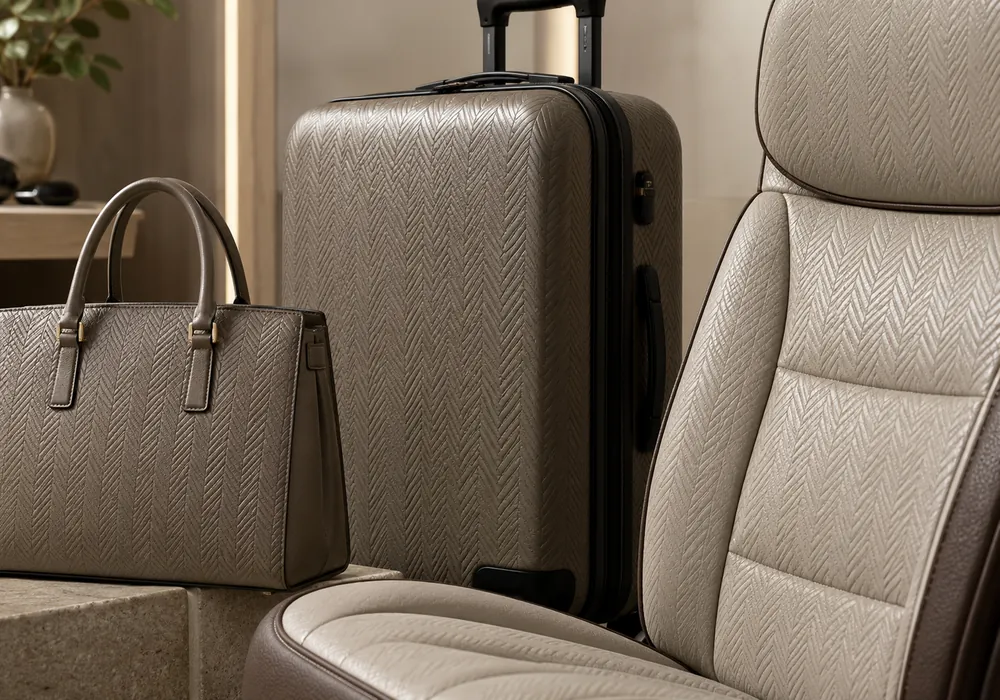
An embossed PVC leather sample lying flat on a table is only the first stage of evaluation.
The surface may look different after the material is manufactured into a finished product.
Bending Changes Light Reflection
When embossed PVC leather is curved, different areas begin reflecting light from different angles.
This can make the grain appear stronger on some parts and weaker on others.
For example, on a handbag:
- Flat front panels may show the complete pattern
- Corners may compress the texture
- Curved edges may catch more highlights
- Folded areas may visually distort the grain
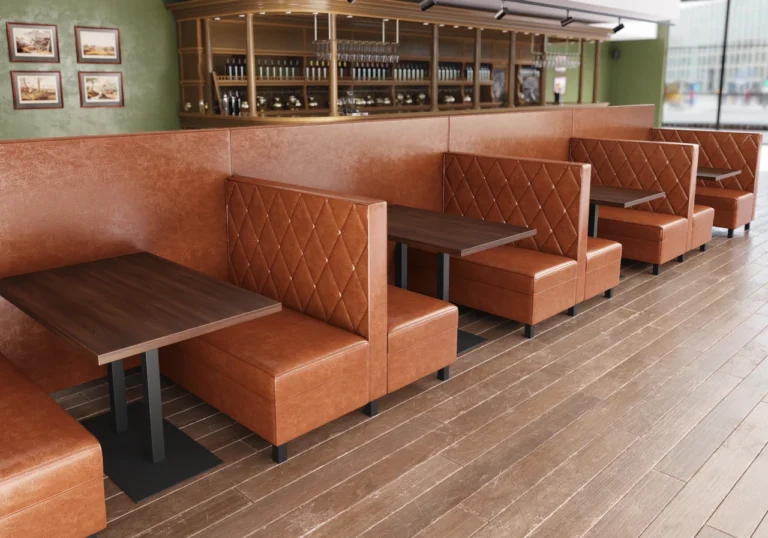
The same principle applies to furniture and automotive upholstery.
Stretching Can Change Pattern Shape
If the material is stretched during upholstery, embossing can become wider or flatter.
This is especially relevant for:
- Car seats
- Motorcycle seats
- Sofa cushions
- Curved chairs
- Other three-dimensional upholstered products
A deep pattern may become less pronounced after stretching.
Directional geometric patterns can also visibly distort if the material stretches unevenly.
Cutting Position Affects Decorative Patterns
Highly decorative embossing needs additional attention during cutting.
A fine random grain usually does not require precise pattern placement.
A large diamond, basket weave or geometric pattern may require the factory to consider:
- Pattern direction
- Panel alignment
- Center position
- Adjacent seam alignment
This can affect both finished appearance and material utilization.
Large Panels Reveal Pattern Repeat More Clearly
A repeating pattern that appears natural on a small swatch may show obvious repetition across a large finished panel.
For products such as luggage, furniture or large handbags, buyers should inspect a larger material area before approval.
Sewing Can Change Visual Balance
Seams divide the embossed surface into separate panels.
If a pattern is directional, inconsistent cutting direction can make adjoining pieces look different even though they come from the same roll.
For visually sensitive products, factories may need to define one cutting orientation.
The broader Bag & Luggage Leather category contains materials with very different surface structures, illustrating why finished-product application should be considered together with surface design.
How to Choose and Approve an Embossed PVC Leather Surface
The best embossing is not necessarily the deepest, most detailed or most decorative pattern.
It is the one that works at the scale and visual style of the finished product.
Start with the Design Direction
First decide what the finished product should look like.
Possible directions include:
- Clean and minimal
- Natural leather-like
- Structured
- Sporty
- Fashion-oriented
- Decorative
- Vintage
- Luxury
- Geometric
- Textile-inspired
This quickly narrows the suitable embossing families.
Compare Several Pattern Scales
If possible, compare more than one version of the same general pattern.
For example:
Fine Basket Weave
Medium Basket Weave
Large Basket Weave
may create very different results even when the material color is identical.
Evaluate a Large Enough Physical Sample
A very small swatch is useful for initial screening but not always sufficient for final approval.
Check enough material to understand:
- Pattern repeat
- Grain scale
- Direction
- Embossing depth
- Surface uniformity
- Appearance at normal viewing distance
Check Color and Finish Together
Do not approve the embossing first and assume every finish will look the same.
Compare the actual production combination.
For example:
Geometric Embossing + Matte Black
may look very different from:
Geometric Embossing + High Gloss Black
even though the embossing roller is identical.
Test the Material in the Finished Product
Whenever practical, manufacture a representative sample.
For bags, check:
- Front panel
- Corners
- Seams
- Folded edges
- Handles or decorative sections
For upholstery, check:
- Stretch over foam
- Grain distortion
- Curved surfaces
- Seam areas
The embossed surface should remain visually balanced after processing.
Confirm the Complete Material Specification
Surface appearance is only one part of the material.
Before bulk production, also confirm:
- Material type
- Thickness
- Width
- Backing
- Color
- Surface Finish
- Hand feel
- Stretch
- Required performance
Backing can change how the material stretches and forms even when the embossed surface is identical.
For more information, see Common PVC Leather Backing Options.
A practical embossed-material approval can therefore record:
| Item | What to Confirm |
|---|---|
| Embossing Pattern | Approved physical pattern |
| Pattern Scale | Fine, medium, large or approved sample |
| Embossing Depth | Approved reference |
| Pattern Direction | Confirm if directional |
| Color | Approved color sample |
| Surface Finish | Matte, glossy, metallic, etc. |
| Thickness | Required construction |
| Backing | Exact backing type |
| Finished Application | Product and component |
| Approved Sample | Physical reference retained |
The embossing pattern should ultimately be approved as part of the complete PVC leather construction, not as an isolated surface design.
Xiangze Leather supplies fine grain, geometric, woven, basket weave, floral and other embossed PVC leather constructions for handbags, luggage, fashion accessories and decorative products.
Buyers can provide a finished-product reference, existing leather sample or preferred texture so suitable embossing scale, surface finish, thickness and backing combinations can be compared before bulk production.