Outdoor Seat Leather for Sightseeing Vehicles: What Buyers Should Check

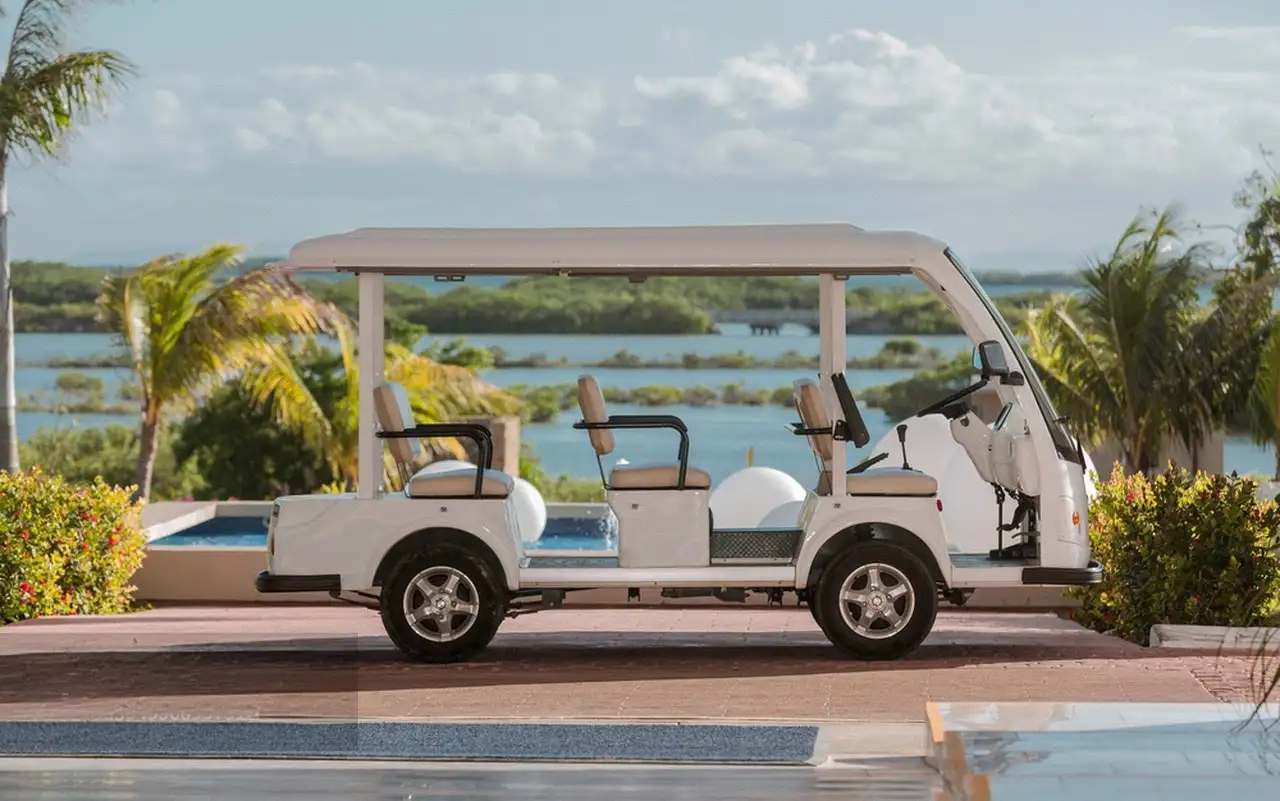
Sightseeing vehicles, golf carts and resort shuttles may look similar to ordinary passenger vehicles, but their seat materials often work in a much harsher environment.
Conventional automotive seats normally remain inside an enclosed cabin. Many sightseeing vehicles, however, use open or semi-open structures, exposing the upholstery to direct sunlight, humidity, rain and larger temperature changes.
This means that regular automotive interior performance alone may not be enough for outdoor tourism vehicles.
Why Sightseeing Vehicle Leather Is Different from Regular Automotive Leather
The difference is easiest to understand by looking at the actual exposure conditions.
| Factor | Regular Automotive Seat | Sightseeing / Golf Cart Seat |
|---|---|---|
| Sunlight | Mainly inside an enclosed cabin | Often direct outdoor sunlight |
| Weather | Protected from direct rain | May face rain and high humidity |
| Temperature | Cabin environment | Larger day/night and seasonal changes |
| Usage | Mostly private vehicle use | Commercial, repeated passenger use |
| Cleaning | Normal interior maintenance | More frequent cleaning |
| Main Material Focus | Interior appearance, abrasion, comfort | Weathering, UV, moisture, flexing, abrasion and cleaning |
For conventional automotive interior trim, SAE J2412 defines accelerated xenon-arc exposure procedures for automotive interior components. The standard also makes clear that exposure duration and final performance criteria are normally defined by the vehicle manufacturer’s material specification.
For materials exposed directly to outdoor weather, SAE J2527 provides a separate xenon-arc exposure method for automotive exterior materials. It should not automatically be treated as a mandatory sightseeing-seat standard, but the distinction shows why direct outdoor exposure is different from conventional interior exposure.
This is the key point:
A material can be suitable for an enclosed automotive interior without automatically being suitable for an open sightseeing vehicle.
Core Problems and Relevant Test Standards
Outdoor seat leather should not be judged by one test result such as “50,000 abrasion cycles.”
Different failure modes require different evaluations.
| Outdoor Seat Problem | What Buyers Need to Evaluate | Useful Reference Methods |
|---|---|---|
| Fading / yellowing | UV and artificial weathering | SAE J2412, ISO 4892-2, ISO 105-B04 |
| Cracking after outdoor aging | Weathering + repeated flexing | ISO 4892-2, ISO 7854 |
| Surface peeling / delamination | Coating adhesion | ISO 2411 |
| Premature wear | Abrasion resistance | ASTM D3884 or agreed abrasion method |
| Stretch / deformation | Tensile strength and elongation | ISO 1421 |
| Dirt and cleaning damage | Soiling and cleaning behavior | VDA 230-212 |
| Fire performance | Horizontal burning behavior | ISO 3795, where applicable |
UV and Weathering
ISO 4892-2 uses xenon-arc exposure together with moisture and controlled environmental conditions to reproduce weathering effects associated with daylight exposure.
For color change specifically, ISO 105-B04:2024 evaluates colour fastness under artificial weathering using xenon-arc exposure and can account for the combined effects of light and water.
Therefore, statements such as:
“UV resistant”
are much less useful than:
tested by a specified method, for a specified exposure period, with defined acceptable color and surface changes.
Cracking and Flexing
Outdoor aging may make a coating less flexible. Repeated seat movement can then accelerate cracking.
ISO 7854 evaluates the resistance of rubber- or plastics-coated fabrics to damage caused by repeated flexing.
This is particularly relevant for vehicles operating in areas with large temperature changes.
Peeling and Delamination
Peeling is not always an abrasion problem.
ISO 2411:2024 specifically measures the adhesion strength between the coating and coated fabric structure.
For outdoor seats, buyers should therefore consider:
abrasion resistance + coating adhesion
rather than treating wear cycles as the only durability indicator.
Cleaning Resistance
Tourism vehicles are regularly exposed to dirt, sunscreen, sweat and cleaning agents.
VDA 230-212 is specifically intended to evaluate the soiling and cleaning behaviour of leather, coated textiles and textiles used in automotive interiors.
That makes cleaning resistance a legitimate procurement consideration rather than simply a maintenance issue.
Different Tourism Projects Need Different Test Priorities
Not every sightseeing vehicle needs the same specification.
| Application | Main Risks | Tests / Properties to Prioritize |
|---|---|---|
| Coastal Resort | UV, humidity, mildew, moisture | Xenon weathering, moisture/mildew evaluation |
| Mountain / High-Altitude Area | Strong UV, temperature variation | UV weathering, flexing, low-temperature performance |
| Theme Park | Heavy use, cleaning, surface wear | Abrasion, coating adhesion, cleaning resistance |
| Golf Course | Direct sunlight, moisture, repeated use | Weathering, abrasion, cleaning |
| Covered Hotel Shuttle | Lower weather exposure | Interior durability, abrasion, appearance stability |
For high-traffic vehicles, abrasion testing is useful, but the test method matters as much as the number of cycles.
ASTM D3884 covers abrasion evaluation using a rotary-platform abrader, but ASTM itself notes that laboratory abrasion performance does not always directly reproduce real-world service behaviour.
So a claim such as:
50,000 cycles
should ideally also identify:
test method → abrasive wheel/material → load → endpoint or failure criterion
The same principle applies to outdoor exposure hours.
There is no universal rule that every sightseeing vehicle seat must pass the same number of xenon-arc hours. SAE J2412 explicitly leaves test duration and performance evaluation to the applicable manufacturer material specification.
What Buyers Should Ask the Supplier
Instead of asking only:
Is this automotive leather?
a tourism-vehicle buyer can ask more useful questions:
| Question | Why It Matters |
|---|---|
| Which UV/weathering method was used? | “UV resistant” alone says very little |
| How long was the exposure? | 500 h and 2,000 h cannot be treated as the same test |
| What was evaluated after aging? | Color, cracking, gloss and mechanical properties may differ |
| Which abrasion method was used? | Cycle numbers from different methods cannot be directly compared |
| Has coating adhesion been tested? | Helps evaluate peeling and delamination |
| Which cleaners were evaluated? | Important for commercial tourism fleets |
| Are flexing or low-temperature tests available? | Important for outdoor temperature changes |
| What flammability requirement applies? | Vehicle and market regulations may differ |
For vehicle interior materials, ISO 3795 is one established method for measuring the horizontal burning behaviour of vehicle interior materials, although the exact legal requirement depends on the vehicle category and destination market.
Xiangze supplies synthetic leather for automotive interiors and outdoor vehicle seating applications. For tourism projects, the material should be evaluated against the actual operating environment and agreed test requirements before bulk production.
The most useful purchasing principle is:
Do not ask only whether the material is “automotive grade.” Ask which test methods were used, what conditions were tested, and what the results actually mean.