UV-Resistant Automotive Seat Leather for Outdoor Use: Selection and Performance

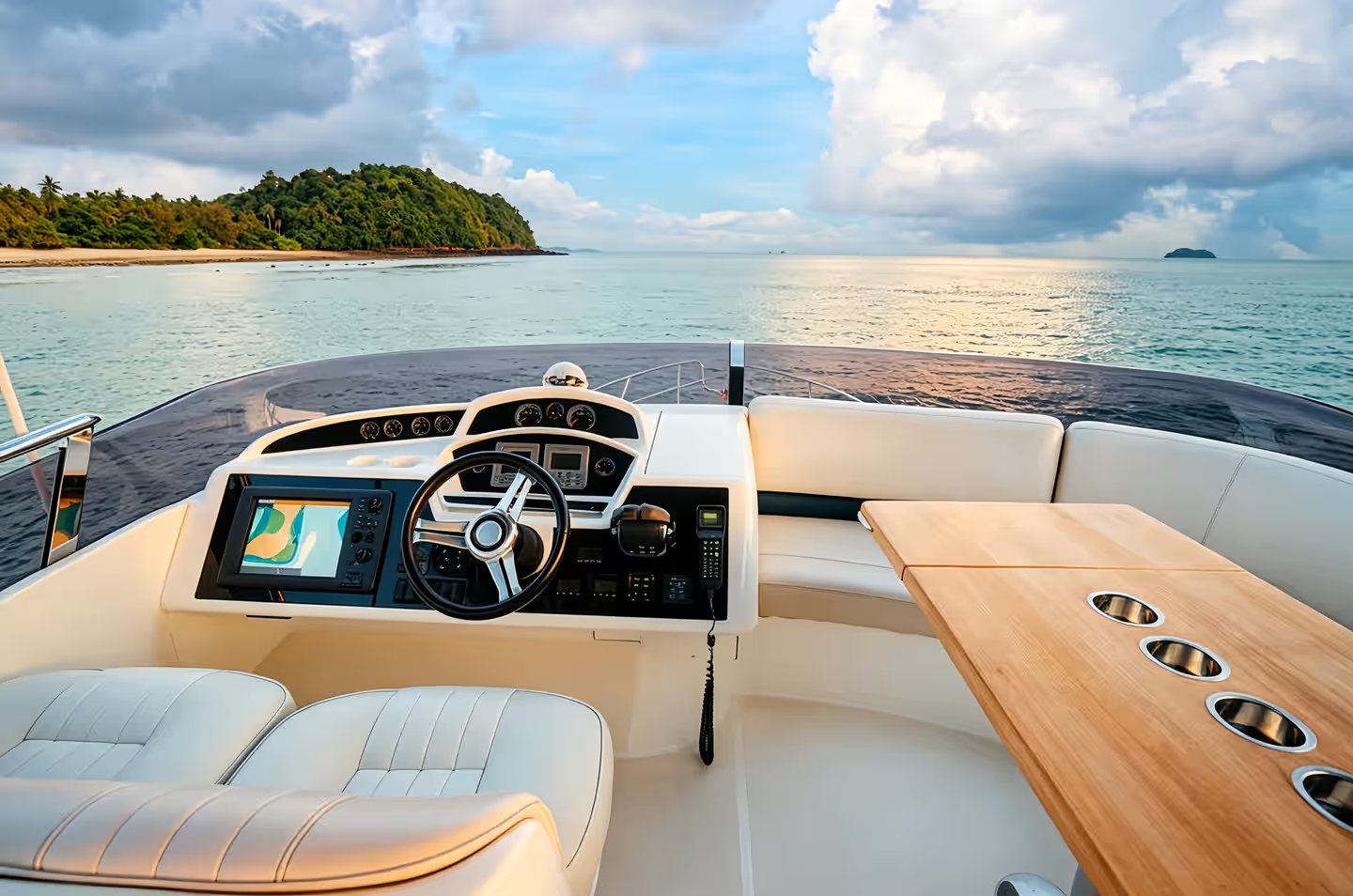
Golf carts, sightseeing vehicles and other outdoor vehicles may remain under direct sunlight for many hours every day.
Compared with conventional automotive interiors, their seats are often exposed more directly to UV radiation, heat, rain, humidity and temperature changes.
This means that a leather material can perform well in a normal vehicle interior but still fade, harden or crack prematurely when used on an open or semi-open vehicle.
For outdoor seating, UV resistance should therefore be treated as part of a complete weathering specification, not simply as a marketing claim.
How UV Exposure Damages Outdoor Seat Leather
Long-term sunlight can gradually change both the appearance and mechanical properties of coated synthetic leather.
Typical outdoor aging problems include:
| Failure | What You May See | Main Concern |
|---|---|---|
| Color fading | Uneven color or whitening | Appearance retention |
| Gloss change | Surface becomes unusually shiny or dull | Top-coat aging |
| Hardening | Leather loses flexibility | Cracking risk |
| Surface cracking | Fine cracks develop during bending | Weathering + flexing |
| Peeling / delamination | Coating begins to separate | Coating adhesion |
| Reduced cleaning resistance | Surface becomes easier to stain or damage | Top-coat deterioration |
UV exposure is rarely the only factor.
A sightseeing vehicle parked outdoors may experience sunlight → high surface temperature → rain or humidity → cooling → repeated seat movement within the same operating cycle.
This is why outdoor durability should not be judged only by abrasion resistance.
For vehicle applications exposed directly to the environment, buyers should consider weathering together with temperature, flexing and surface stability.
What Makes a Synthetic Leather More Suitable for Outdoor UV Exposure?
Outdoor resistance does not come simply from making the leather thicker.
The performance depends on the complete coating system.
A weather-resistant construction may use a combination of:
UV absorbers → light stabilizers → weather-resistant coating resin → protective top coat → suitable pigment system
UV absorbers help reduce the amount of damaging radiation reaching the polymer system, while light stabilizers can help slow photo-oxidative degradation.
The top coat is also important because it is the first layer exposed to sunlight, cleaning products and physical contact.
This explains why two synthetic leather samples with the same thickness and similar grain can perform very differently outdoors.
Regular Automotive Interior vs Outdoor Vehicle Seat Material
| Selection Point | Regular Enclosed Automotive Interior | Outdoor / Sightseeing Vehicle |
|---|---|---|
| Sunlight | Mainly through vehicle glazing | Often direct sunlight |
| Rain / Moisture | Normally limited | Direct or indirect exposure possible |
| UV Requirement | Interior light-aging performance | Greater emphasis on outdoor weathering |
| Temperature | Cabin heat | Outdoor heat + larger temperature variation |
| Flexibility | Normal seat use | Must remain stable after weather aging |
| Cleaning | Normal interior maintenance | Often more frequent |
| Main Evaluation | Interior durability and appearance | Weathering + durability + surface stability |
The important difference is therefore exposure environment, not simply whether the material is called “automotive leather.”
Which Tests Matter for UV-Resistant Outdoor Seat Leather?
A professional specification should identify the actual test method rather than simply state “UV resistant.”
| Performance | Useful Reference | What It Evaluates |
|---|---|---|
| Automotive interior xenon aging | SAE J2412 | Accelerated exposure of automotive interior trim |
| Xenon-arc weathering | ISO 4892-2 | Light + temperature + humidity/wetting |
| Color fastness to weathering | ISO 105-B04 | Color change under xenon artificial weathering |
| Abrasion | ASTM D3884 / agreed method | Surface wear |
| Coating adhesion | ISO 2411 | Bonding between coating and substrate |
| Flexing after aging | Relevant flex test such as ISO 7854 | Resistance to cracking under repeated flexing |
SAE J2412:2024 is specifically designed for accelerated xenon-arc exposure of automotive interior trim. Importantly, SAE states that the actual test duration and performance criteria are normally defined by the individual automotive manufacturer’s material specification.
ISO 4892-2 exposes materials to xenon-arc light together with moisture, temperature and humidity conditions to reproduce weathering effects associated with daylight or daylight filtered through glass. The current published 2013 edition was confirmed in 2023, while a new edition is under development.
For color change, ISO 105-B04:2024 specifically evaluates colour fastness under artificial xenon weathering and can account for the combined action of light and water.
Abrasion is still useful, but the number of cycles should never be read without the test conditions. ASTM D3884 covers rotary-platform abrasion testing and specifies the testing method rather than one universal pass/fail cycle requirement.
So instead of asking only:
“Can it pass 50,000 cycles?”
a buyer should ask:
Which method, abrasive medium, load and failure criterion were used?
The same applies to UV exposure hours.
500 hours, 1,200 hours or 2,000 hours are meaningless without knowing the test method and acceptance criteria.
Common Purchasing Mistakes
| Common Assumption | Better Purchasing Approach |
|---|---|
| Dark colors are naturally UV resistant | Check xenon/weathering data |
| Thicker leather lasts longer outdoors | Evaluate coating formulation and aging performance |
| High abrasion = outdoor durability | Check UV, adhesion and flexing as well |
| “Automotive grade” automatically means outdoor grade | Confirm actual exposure and test conditions |
| More UV hours always means better material | Compare test method, irradiance and acceptance criteria |
| ISO/TS 16949 proves product durability | Quality-system certification and product performance testing are different things |
The last point is especially important.
IATF 16949:2016 is an automotive quality-management-system standard; it replaced ISO/TS 16949:2009. It helps define automotive supply-chain quality-management requirements, but it does not by itself prove that a particular leather has passed a specific UV or abrasion test.
For golf carts, sightseeing vehicles and other outdoor seating projects, the better purchasing sequence is:
define outdoor exposure → select the required weathering method → set acceptance criteria → evaluate the physical sample → confirm production specification
Xiangze supplies synthetic leather for automotive interiors and outdoor vehicle seating applications. For suitable projects, higher abrasion targets such as Taber testing up to 50,000 cycles can also be discussed according to the agreed test conditions.
The key is not simply to buy a material labelled “UV-resistant leather.”
It is to know how the material was tested, under what conditions, and what changed after the test.