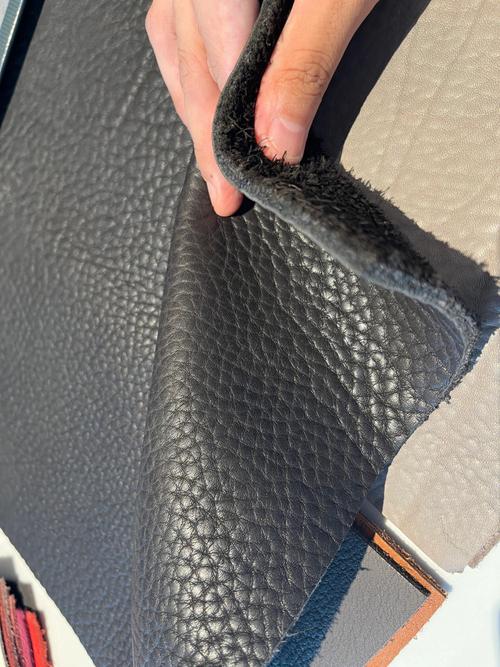
Why PVC Leather Wrinkles or Turns White When Folded

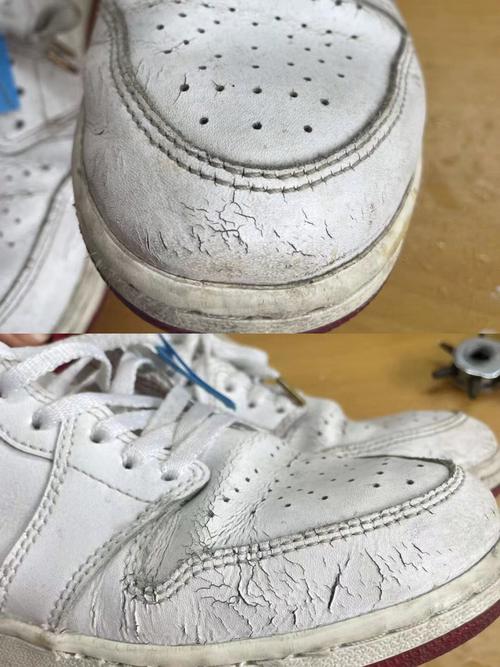
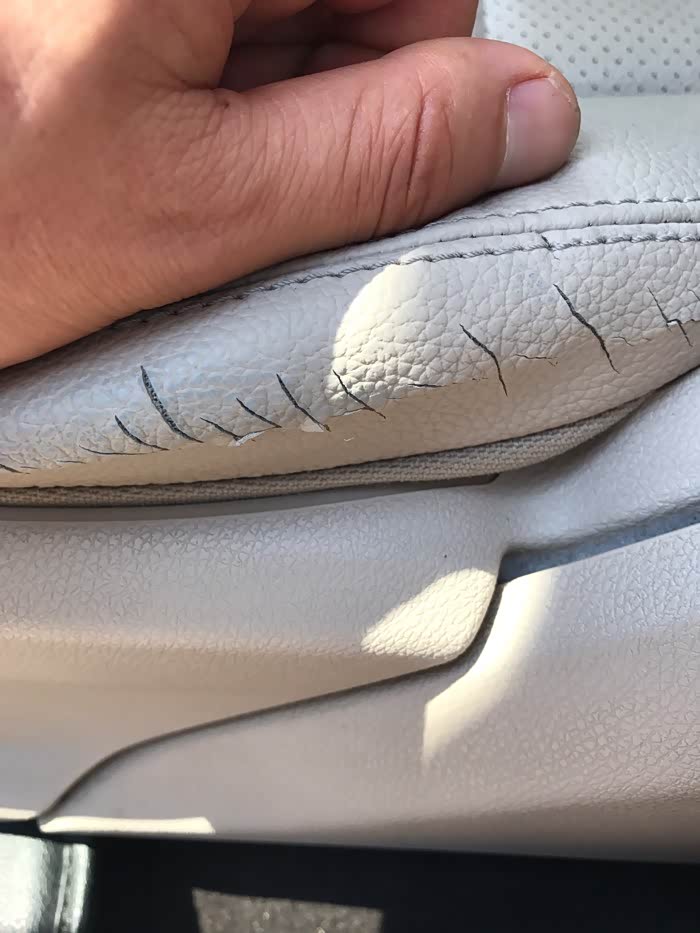
PVC leather can look completely normal when it is flat but develop wrinkles, crease marks or temporary white areas after being sharply folded.
For bag manufacturers, these changes are especially noticeable around gussets, corners, flaps, folded edges and small accessories.
The cause is usually not one single factor. Folding performance depends on the PVC coating, backing fabric, total thickness, surface finish, temperature and the radius of the fold.
Understanding these factors makes it easier to determine whether a material is suitable for a particular bag construction.
Why PVC Leather Can Turn White During Folding
When PVC leather is bent sharply, the outer surface of the fold is stretched while the inner side is compressed.
This deformation can temporarily change how light reflects from the surface.
As a result, the folded area may appear:
- Lighter in color
- Slightly cloudy
- White along the bend line
- Different in gloss from the surrounding surface
This is often called whitening, stress whitening or a folding white mark.
A small temporary color change does not always mean that the coating has failed.
The important question is whether the mark disappears after the material returns to its original shape or remains as permanent surface damage.
| Folding Result | What It May Indicate |
|---|---|
| White mark disappears after release | Temporary deformation |
| Light crease remains | Surface or coating has been permanently deformed |
| Surface cracks | Fold exceeds material flexibility |
| Coating separates | Possible adhesion or construction problem |
| Backing remains stretched | Excessive deformation in the supporting fabric |
For bag applications, the material should therefore be tested at the actual folding radius expected in production.
Coating Thickness and Formulation Affect Folding
The PVC coating itself has a major influence on folding behavior.
A softer and more flexible coating can generally tolerate a tighter bend than a harder, more rigid surface construction.
Factors that influence the result include:
- PVC coating thickness
- Plasticizer system
- Surface coating
- Embossing depth
- Gloss or matte finish
- Printed or metallic layers
- Overall material hardness
A thick material is not automatically more resistant to folding.
In fact, increasing thickness can sometimes create a larger difference between compression on the inside of the fold and stretching on the outside.
Very deep embossing can also make local stress more visible because the raised and recessed areas do not deform uniformly.
Metallic, high-gloss or heavily finished surfaces may show fold marks more clearly than ordinary matte grains even when the base material remains intact.
Backing Fabric Changes the Way the Material Bends
The backing fabric supports the PVC layer and controls part of the material’s stretch and recovery.
This is why two PVC leathers with the same thickness can behave differently when folded.
A flexible knitted or brushed backing may allow the complete material to bend more easily.
A more dimensionally stable woven structure may restrict movement and create a firmer fold.
Backing density, fabric weight and stretch direction also matter.
For example:
Same PVC surface + different backing = different folding behavior
A material that folds smoothly in one direction may show more resistance when folded in another direction if the backing has directional stretch.
For a deeper explanation of backing structures, see PVC & Synthetic Leather Backing Fabrics: Types, Structures and Applications.
You can also refer to How Backing Fabric Changes PVC Leather for Bags when selecting material specifically for handbags, backpacks and luggage.
Why PVC Leather Wrinkles Around Bag Corners
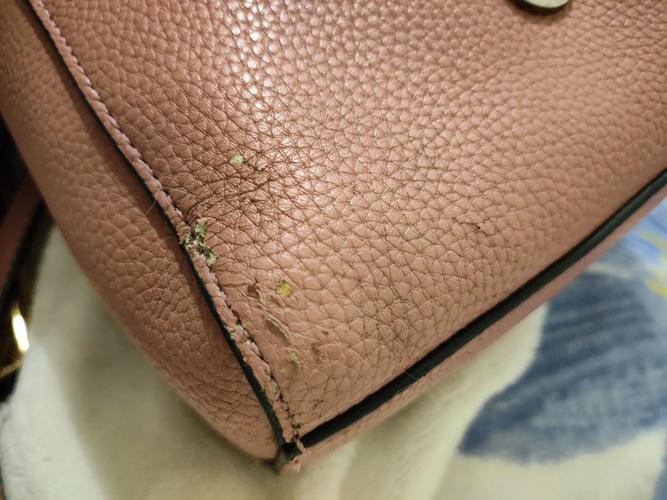
Wrinkles are not always caused by a material defect.
They can also result from the geometry of the bag.
When a flat sheet of synthetic leather is forced around a three-dimensional corner, excess material must be compressed somewhere.
This can create:
- Small radial wrinkles
- Creasing around curved corners
- Uneven folding around gussets
- Surface waves around reinforcement
- Local stress near stitching
The tighter the corner radius, the greater the deformation.
Bag construction also changes the result.
For example, a material may behave differently depending on:
| Construction Factor | Possible Effect |
|---|---|
| Tight fold radius | More concentrated stress |
| Thick reinforcement | Increased bending resistance |
| Multiple material layers | More bulk around the fold |
| Foam underneath | Softer shape but greater compression |
| Adhesive lamination | Can restrict material movement |
| Dense stitching | Concentrates stress near seam lines |
This is why a material that performs well as a flat panel may still wrinkle when used around a sharply curved bag corner.
Reducing the folding angle, increasing the radius or changing the internal reinforcement can sometimes improve the result without changing the leather itself.
How to Check Folding Performance Before Production
The most useful approach is to test the synthetic leather under conditions close to the actual bag design.
Start with a simple fold test.
Fold the material at several radii rather than making only one extreme 180-degree crease.
Observe:
- Whether the surface turns white
- Whether the color recovers
- Whether wrinkles remain
- Whether the coating cracks
- Whether the backing stretches
- Whether layers separate
Then repeat the test using the actual production structure.
Include the intended:
- Lining
- Reinforcement
- Foam
- Adhesive
- Stitching
- Edge treatment
A material may behave very differently once these layers are combined.
For important projects, producing a small trial panel or prototype bag is more reliable than judging folding performance from a hand sample alone.
See How to Test Synthetic Leather Before Bag Production for a broader pre-production evaluation process.
If persistent whitening, cracking or severe wrinkling appears during the prototype stage, possible solutions include adjusting material thickness, changing the backing construction, increasing the fold radius or selecting a more flexible surface construction.
Xiangze Leather supplies PVC synthetic leather in different thicknesses, grains and backing constructions for bags, furniture, footwear, automotive interiors and decorative applications.
For bag projects, material samples can be evaluated according to the intended folding, sewing and reinforcement structure before confirming bulk production.