How to Test Synthetic Leather Before Bag Production

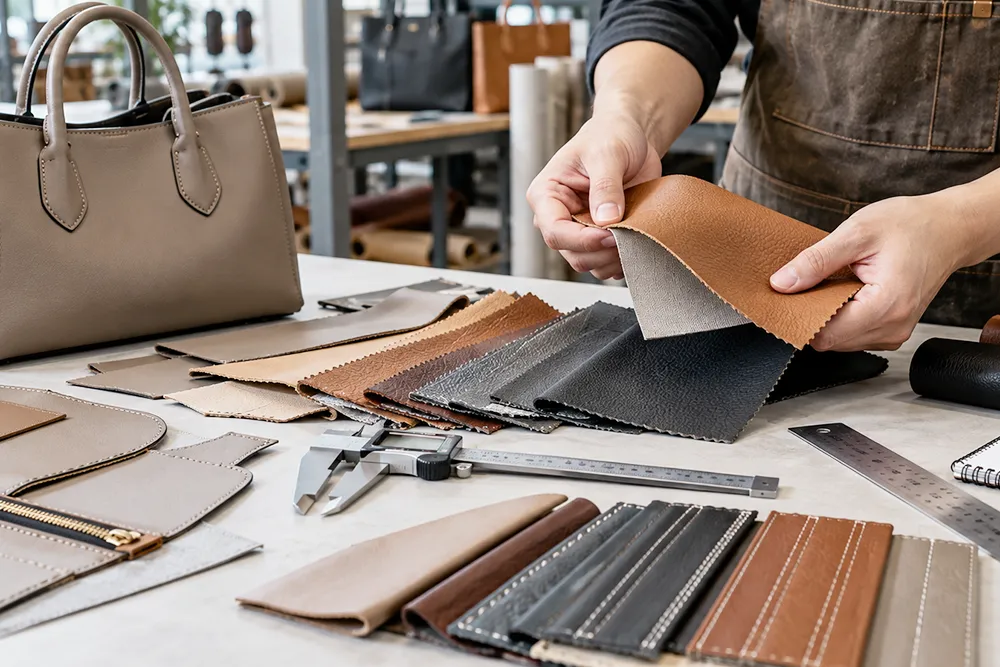
A synthetic leather sample may look suitable when it first arrives, but appearance alone does not show how the material will behave during actual bag production.
Cutting, sewing, folding, edge finishing and reinforcement can reveal problems that are difficult to identify from a small swatch.
Before confirming a bulk order, bag manufacturers should evaluate the material in conditions as close as possible to the intended production process.
The goal is not to perform every possible laboratory test. It is to identify whether the material is suitable for the specific bag design, component and manufacturing method.
Start With the Basic Material Specification
Before testing performance, confirm that the sample matches the requested specification.
Check:
| Item | What to Confirm |
|---|---|
| Surface | Grain, embossing, gloss and color |
| Material type | PVC, PU or other synthetic leather |
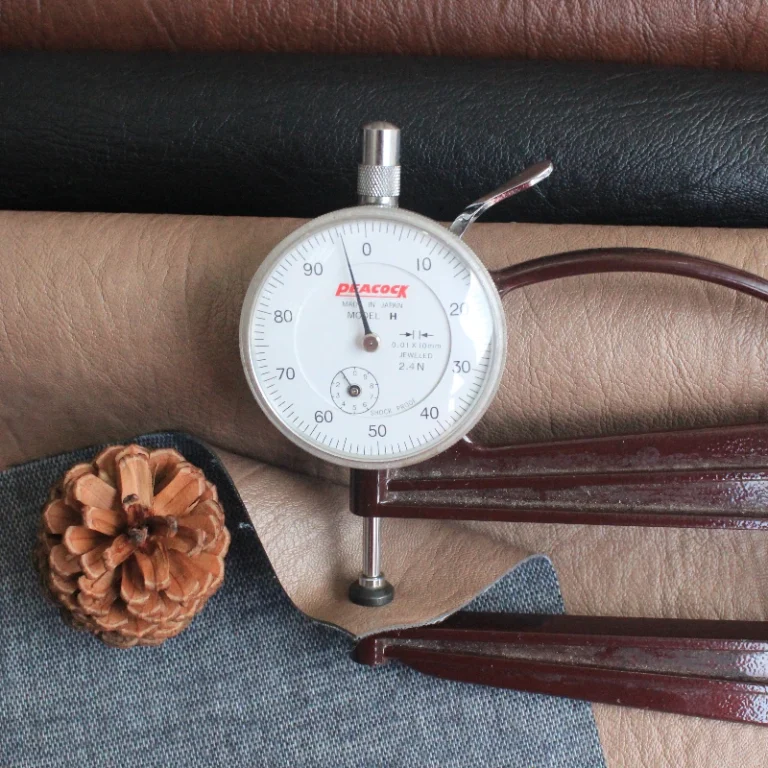
| Thickness | Total finished thickness |
| Width | Whether it meets cutting requirements |
| Backing | Fabric type and construction |
| Flexibility | Soft, medium or structured behavior |
| Stretch | Direction and amount of movement |
| Surface consistency | Color and grain uniformity |
Thickness should be checked at several points rather than at only one position.
The backing should also be confirmed because two synthetic leathers with similar surface appearance and thickness can behave differently when different backing fabrics are used.
For more detail, see How Backing Fabric Changes PVC Leather for Bags and PVC Leather Thickness for Bags: How to Choose.
Test the Material the Way It Will Be Processed
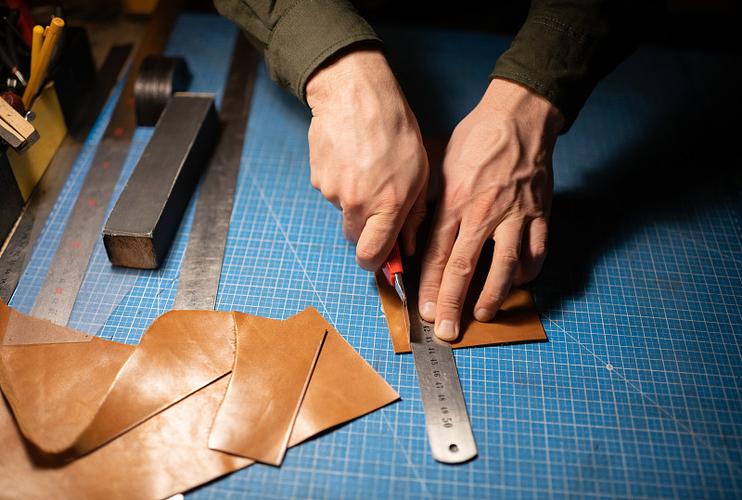
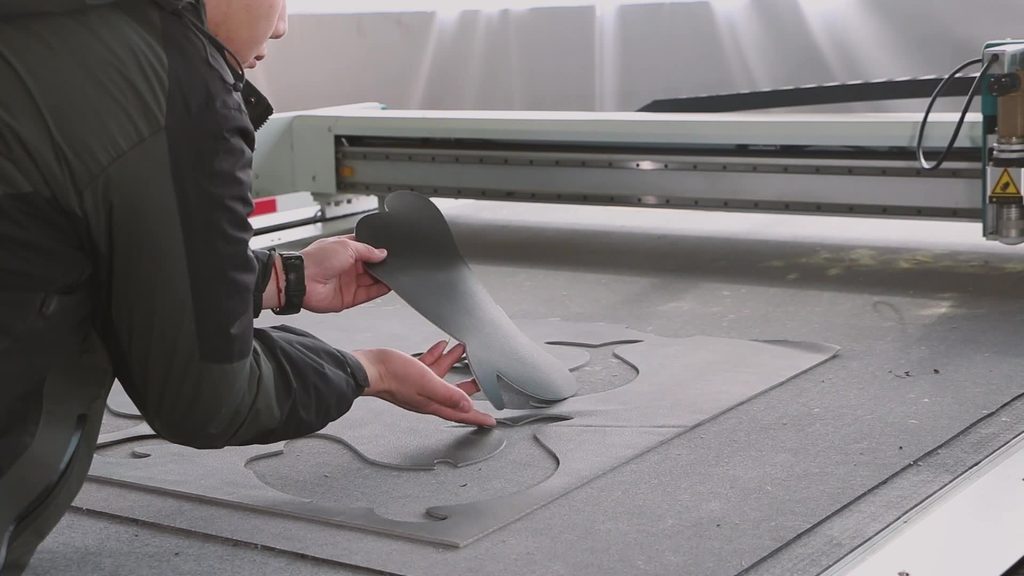
The most useful test is often to run the synthetic leather through the same processes that will be used in production.
Cutting
Check whether the material:
- Cuts cleanly
- Moves or stretches during cutting
- Distorts around small components
- Produces stable panel dimensions
- Shows excessive edge curling
Large bag panels usually reveal dimensional problems more clearly than small sample pieces.
Sewing
Use the intended needle, thread and stitch spacing.
Observe:
- Whether the material feeds smoothly
- Whether the backing stretches during sewing
- Whether the seam remains flat
- Whether stitch holes enlarge
- Whether the coating cracks around the stitching
- Whether multiple layers create excessive bulk
A material that looks suitable as a flat sheet may behave differently once several layers are sewn together.
Folding and Turning
Fold the material around the radius expected in the finished bag.
Check:
- Surface whitening
- Wrinkling
- Coating cracking
- Excessive stiffness
- Recovery after bending
- Bulk at folded edges
This is especially important for gussets, flaps, corners, wallets and small folded components.
Check Surface and Mechanical Performance
Production trials should be combined with basic performance testing where the application requires it.
Abrasion
Bag surfaces are repeatedly rubbed against clothing, tables, luggage compartments and other objects.
Abrasion testing can help compare how different materials respond to repeated surface wear.
For development projects, comparative testing is often more useful than looking at one isolated number.
Tear Resistance
Tear resistance is important around:
- Stitching areas
- Handles
- Straps
- Hardware attachment points
- Corners
- Loaded bag panels
The backing construction can significantly influence how a synthetic leather behaves after a cut or stitch hole has already been introduced.
Surface Rubbing and Color Transfer
Rub the surface with light-colored fabric under both dry and, where relevant, slightly damp conditions.
Check whether:
- Color transfers
- Surface finish changes
- Gloss changes significantly
- Printed or coated effects are damaged
This is particularly useful for dark colors, metallic finishes, printed surfaces and heavily coated decorative materials.
Coating Adhesion
The surface coating and textile backing should remain stable during folding, sewing and repeated handling.
Watch for:
- Separation between layers
- Surface lifting near cut edges
- Peeling after repeated bending
- Weak areas around seams
More demanding projects can use formal laboratory testing according to the buyer’s required test method.
Make a Trial Bag or Representative Panel
A material test becomes much more useful when it includes the actual bag construction.
If possible, make either a complete prototype or at least a representative production panel.
Use the real:
- Lining
- Reinforcement
- Foam
- Adhesive
- Thread
- Hardware
- Edge paint
- Sewing method
This allows several material characteristics to be evaluated at the same time.
For example, a relatively soft synthetic leather may appear unsuitable when tested alone but perform well after internal reinforcement is added.
The opposite can also happen: a material with good hand feel may become too thick once backing, foam, lining and reinforcement are combined.
For this reason, synthetic leather should be evaluated as part of the finished bag structure, not only as an individual sheet material.
Approve the Material Before Bulk Production
Before confirming bulk production, compare the sample against the actual requirements of the bag.
A practical approval checklist can include:
| Check | Result |
|---|---|
| Color and grain approved | Pass / Review |
| Thickness confirmed | Pass / Review |
| Backing confirmed | Pass / Review |
| Cutting behavior acceptable | Pass / Review |
| Sewing behavior acceptable | Pass / Review |
| Folding and edge processing acceptable | Pass / Review |
| Abrasion performance suitable | Pass / Review |
| Tear performance suitable | Pass / Review |
| Surface rubbing acceptable | Pass / Review |
| Prototype approved | Pass / Review |
The required level of testing depends on the product.
A lightweight fashion pouch may require relatively simple production checks, while luggage, backpacks or bags carrying heavier loads may require more detailed mechanical testing.
For custom projects, buyers should also provide any required test method, acceptance limit or customer standard before bulk production begins.
Xiangze Leather supplies synthetic leather for bags and luggage in different thicknesses, backing constructions, grains and finishes.
Samples can be evaluated for material structure and production suitability before confirming bulk specifications. For application-specific material selection, see Synthetic Leather for Bags & Luggage.