How Backing Fabric Changes PVC Leather for Bags

When selecting PVC leather for handbags, backpacks or luggage, buyers often compare the surface grain, color and thickness first.
However, two materials with a similar PVC surface and the same nominal thickness can behave very differently during cutting, sewing, folding and final assembly.
One of the main reasons is the backing construction.
The backing supports the coated surface and can influence flexibility, stretch, dimensional stability, material body and processing behavior. For bag manufacturers, it should therefore be selected together with thickness, surface construction and the finished bag design.
For a complete explanation of backing structures and terminology, see PVC & Synthetic Leather Backing Fabrics: Types, Structures and Applications.
Why the Same PVC Leather Can Behave Differently
PVC synthetic leather is a layered material.
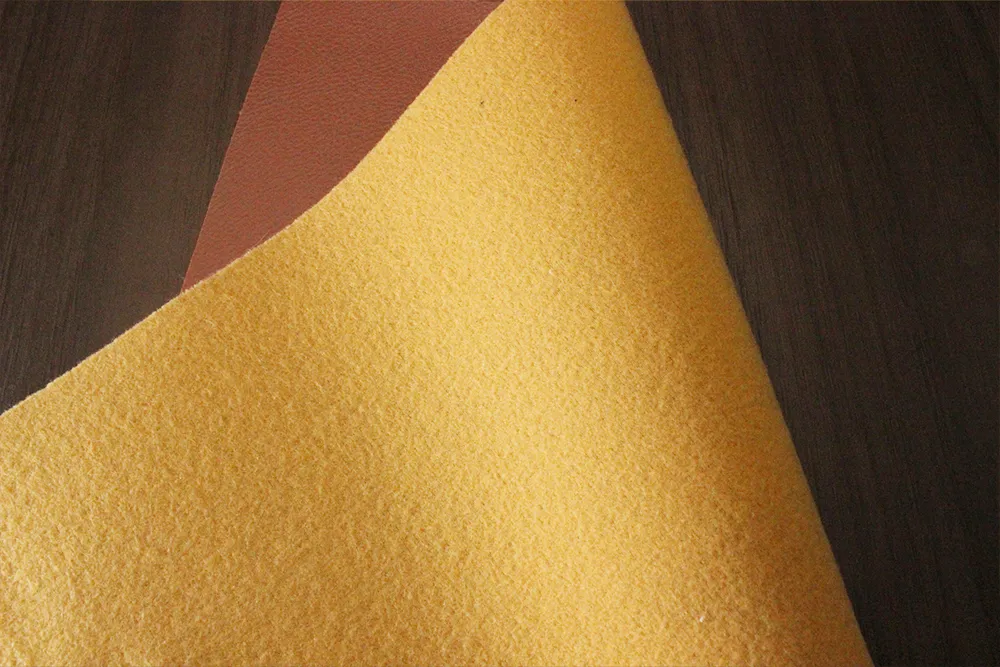
The visible PVC surface determines much of the color, grain and surface finish, while the textile or supporting layer underneath contributes to the behavior of the complete material.
For bags, backing can influence:
- Flexibility
- Stretch and recovery
- Dimensional stability
- Material body
- Folding behavior
- Sewing performance
- Stitch-hole behavior
- Edge finishing
- Skiving
- Panel handling
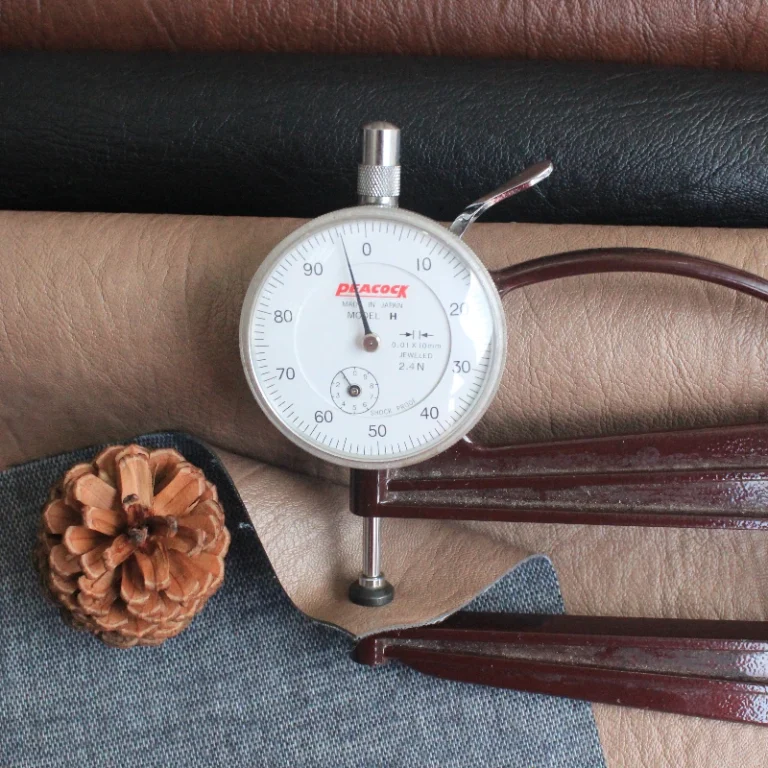
This is why thickness alone does not fully describe bag leather.
For example, two materials may both measure 0.8 mm, but one may use a flexible brushed backing while another uses a relatively stable woven backing.
The first may bend and fold more easily, while the second may provide more controlled panel dimensions.
Neither construction is automatically better. They are designed for different manufacturing requirements.
The relationship can be understood as:
PVC surface + backing construction + thickness + reinforcement + bag design
rather than thickness alone.
For more detail on this relationship, see PVC Leather Thickness for Bags: How to Choose.
Understand the Backing Name Before Comparing Materials
Not every backing name describes the same type of textile information.
This is important when comparing specifications from different suppliers.
Fabric Structure
Terms such as Knitted Fabric Backing and Woven Fabric Backing describe how yarns are constructed.
Knitted structures use interlocking loops and can provide greater flexibility depending on density and yarn construction.
Woven structures use crossing warp and weft yarns and generally provide more controlled dimensional behavior.
Denim and Oxford are examples of woven textile constructions used in selected synthetic leather products.
Surface or Processing Description
Brushed Fabric Backing refers to a textile surface that has been brushed to create a raised fiber surface.
Single-Needle Brushed Fabric Backing and Double-Needle Brushed Fabric Backing are commercial construction descriptions used for particular backing materials.
These names should not be treated as universal performance grades.
Actual fabric weight, density, thickness and stretch still need to be confirmed.
Loop, Fleece and Fiber-Based Constructions
Terry Fabric Backing uses a loop-textured textile structure and is found in a number of PVC bag leather products.
Toweling Backing is closely related to terry or towel-like backing in commercial terminology. Two materials using these names should not automatically be assumed to have exactly the same weight, loop density or stretch.
For general technical communication, Terry Fabric Backing is the clearer standard term, while existing products specifically identified as Toweling Backing can retain their confirmed product specification.
Other constructions such as Imitation Cotton Fleece, Needle-Punched Cotton and Microfiber Backing describe different fiber or textile structures and can provide different levels of softness, material body and support.
The backing name is therefore only the first part of the specification.
How Common Backings Change Bag Leather
Different backing constructions change the balance between flexibility, structure and production handling.
| Backing Direction | Typical Effect on the Complete Material | Bag Manufacturing Considerations |
|---|---|---|
| Brushed Fabric | Flexible textile support with additional body | Folding, sewing and general bag panels |
| Single-Needle Brushed | Relatively lightweight brushed construction depending on specification | Soft or flexible bag components |
| Double-Needle Brushed | Can provide more body and textile support depending on density | Larger or more structured panels |
| Knitted Fabric | Flexible looped construction | Curves, soft panels and flexible components |
| Woven Fabric | More controlled stretch and dimensional stability | Structured panels and accurate cutting |
| Denim Fabric | Woven support with controlled panel behavior | Handbags, luggage and fashion materials |
| Oxford Fabric | Relatively structured woven support depending on fabric weight | Luggage and structured accessories |
| Terry Fabric | Loop-textured backing with flexibility and material body | Handbags and general sewn bag materials |
| Toweling Backing | Terry-related commercial construction | Evaluate weight, loop density and thickness |
| Imitation Cotton Fleece | Softer, fuller reverse-side construction | Hand feel, folding and seam bulk |
| Needle-Punched Cotton | Dense fiber-based structure with additional body | Heavier or more structured components |
| Microfiber Backing | Fine-fiber supporting structure | Flexible higher-specification constructions |
These are selection directions rather than fixed performance standards.
Backing density, fabric weight, yarn construction and the PVC coating itself can significantly change the final result.
For example, not every woven backing is necessarily stiff, and not every knitted backing is extremely stretchy.
The physical material should always be evaluated as a complete construction.
Match the Backing to the Bag Component
Selecting backing only according to the general product name—such as “handbag” or “backpack”—can still be too broad.
Different parts of the same bag may require different material behavior.
| Bag Component | Important Material Behavior |
|---|---|
| Main body panel | Balance of material body, flexibility and dimensional stability |
| Gusset / side panel | Easier bending and forming |
| Bag bottom | More structural support and reinforcement |
| Flap | Controlled folding and surface appearance |
| Handles / straps | Stitching, reinforcement and dimensional stability |
| Decorative panel | Surface design with suitable cutting and sewing behavior |
| Small folded components | Low bulk and clean folding |
| Luggage panel | Panel stability and controlled stretch |
A soft handbag body may use a flexible backing while the handles or bottom rely heavily on internal reinforcement.
Likewise, a structured handbag does not necessarily require extremely stiff PVC leather. Shape can also come from board, foam, lining or other reinforcement inside the finished product.
Backing therefore needs to be selected as part of the complete bag construction, not as an isolated material feature.
This is also why Synthetic Leather for Bags & Luggage should be evaluated according to the finished product, processing method and required material behavior.
What to Check Before Ordering PVC Bag Leather
A backing name alone is not enough for bulk purchasing.
When comparing PVC leather for bags, confirm:
- Exact backing type
- Fabric construction
- Total material thickness
- Backing weight or density where necessary
- Stretch direction and level
- Flexibility
- Material body
- Folding behavior
- Sewing performance
- Edge finishing
- Skiving requirements
- Reinforcement method
A small swatch is useful for checking color, grain and reverse-side appearance.
For production evaluation, a larger sample is more useful because it allows the factory to test actual cutting, sewing, folding, skiving, edge painting and hardware installation.
For important projects, producing a representative panel or a trial bag before bulk production provides a more reliable evaluation than judging the backing only by hand feel.
Xiangze Leather supplies PVC leather for bags and luggage with different surface designs, thicknesses and backing constructions for handbags, backpacks, luggage, wallets and fashion accessories.
When requesting samples, provide the bag type, intended component, preferred surface, thickness and required material behavior so different constructions can be compared before bulk production.