A Practical Guide to Color Matching PVC Leather for Automotive Interiors

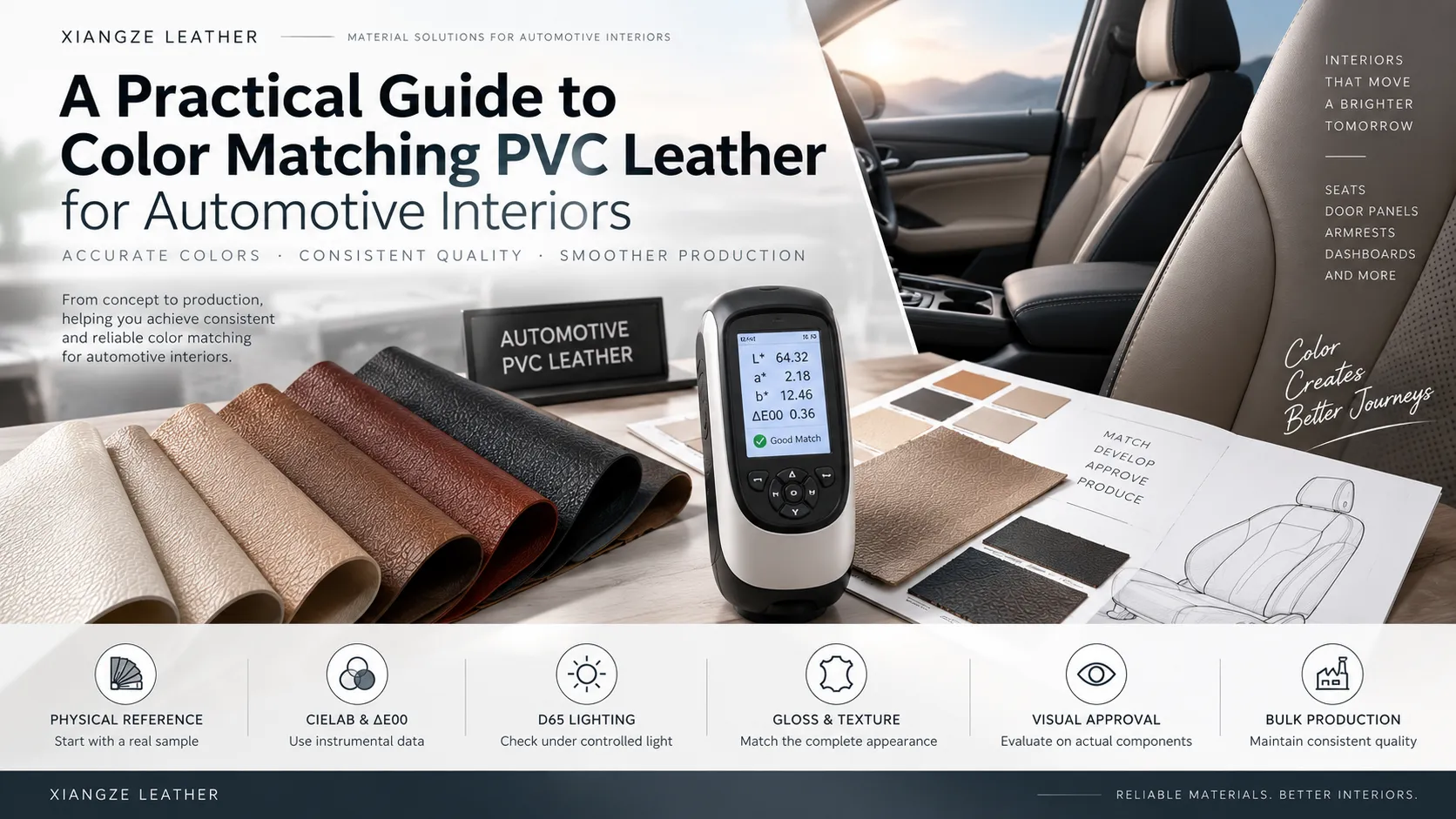
Automotive interior color matching is more difficult than simply choosing “black,” “beige” or “brown.”
A seat, door panel, armrest and dashboard trim may use different materials but still need to appear visually coordinated inside the same vehicle.
For PVC leather buyers, the practical goal is therefore not only to reproduce a color number.
It is to make sure the color, gloss, grain and lighting response work together on the finished interior.
Start With a Physical Master, Not a Screen Image
Photos, PDF color charts and monitor images are useful for initial communication, but they should not be the final reference for automotive color approval.
A physical master sample provides much more information.
| Reference | Reliability for Final Matching |
|---|---|
| Phone photo | Useful only for initial discussion |
| Digital color value | Helpful as supporting information |
| Printed color card | Better, but printing can introduce variation |
| Existing automotive component | Very useful |
| Approved physical leather sample | Best production reference |
A useful request might be:
Automotive seat PVC leather, warm beige, fine grain, matte finish. Physical reference sample available.
This is much more precise than:
Please make beige automotive leather.
If an existing material already exists, the physical sample should normally become the main comparison reference throughout development and bulk production.
For automotive applications, buyers can first identify the intended component through Synthetic Leather for Automotive Interiors.
Use Instrumental Color Data Together With Visual Approval
Color instruments can convert a measured surface into numerical coordinates.
The CIE L*a*b* system describes color through:
| Value | Meaning |
|---|---|
| L* | Lightness |
| a* | Red ↔ Green direction |
| b* | Yellow ↔ Blue direction |
ISO/CIE 11664-4 defines the CIE 1976 L*a*b* color space and methods for calculating color differences.
For industrial color matching, ΔE values are commonly used to describe the numerical difference between the reference and the new sample.
ASTM D2244-25 covers calculation of color tolerances and color differences from instrumental measurements and recommends modern color-difference methods such as CIEDE2000 (ΔE00) for small industrial color differences. Importantly, it also states that the buyer and seller should agree on the acceptable tolerance rather than assuming one universal ΔE value for every product.
So buyers should avoid rules such as:
“ΔE below 1.0 is always acceptable.”
A better specification is:
Measurement method + lighting condition + color-difference formula + agreed tolerance + visual approval
This is more useful for actual production control.
Texture, Gloss and Lighting Can Change the Perceived Color
Two PVC leather samples can have very similar instrumental color values and still look different inside a vehicle.
Why?
Because appearance is influenced by more than pigment.
| Factor | Possible Visual Effect |
|---|---|
| Deep grain | Creates more shadows and may appear darker |
| Fine grain | Often appears more uniform |
| High gloss | Produces stronger reflections |
| Matte finish | Can appear softer or less saturated |
| Perforation | Changes the visible light/dark balance |
| Surface coating | May slightly change hue or gloss |
ASTM D2244 specifically notes that gloss and texture can affect the relationship between measured color difference and visual acceptability.
Lighting is another issue.
A pair of samples may match under daylight but look different under another light source. This is known as metamerism.
For reference, ISO 22700 for finished leather uses D65 daylight as the standard light source and D65/10° conditions for color matching and metamerism evaluation. Although this standard is written for finished leather rather than specifically for PVC-coated synthetic leather, the principle is useful: color matching should be checked under controlled lighting rather than only under factory or office lighting.
For automotive projects, it is therefore useful to check the approved sample under more than one relevant lighting condition.
Approve the Color Before Bulk Production
The safest color-matching process is not:
photo → color formula → bulk production
It is:
reference → trial sample → measurement → visual comparison → component evaluation → approved master → bulk production
A practical approval process can look like this:
| Stage | What to Confirm |
|---|---|
| Reference | Physical master or existing component |
| Trial Sample | Initial PVC leather color |
| Instrument Check | L*a*b* / ΔE00 comparison |
| Visual Check | Color, gloss and grain |
| Lighting Check | Daylight and other relevant lighting |
| Component Check | Compare with seat, door panel or trim |
| Approval | Sign or retain approved physical sample |
| Bulk Control | Compare production against approved master |
One particularly important point is component proximity.
A slight color difference may be acceptable when two materials are far apart, but much more noticeable when they meet directly along a seam or adjacent trim panel. ASTM D2244 also notes that specimen proximity can influence commercial color acceptability.
For this reason, automotive PVC leather should ideally be approved together with the surrounding interior materials whenever possible.
The practical rule is simple:
Do not approve automotive PVC leather by color number alone. Approve the physical material—color, grain, gloss and lighting response together.
For projects requiring color matching from an existing reference, buyers can also see How to Match PVC Leather from an Existing Material Sample or contact Xiangze Leather with the reference material and automotive application.