Best Backing Materials for Motorcycle Seat Leather

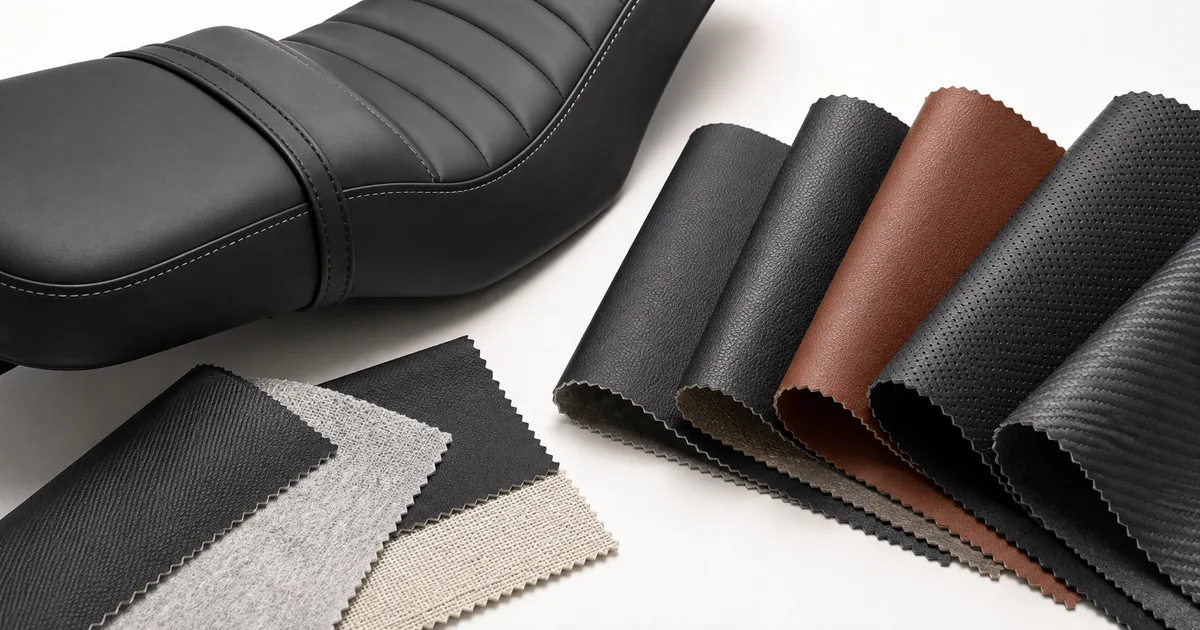
The best backing material for motorcycle seat leather depends on the shape of the seat, the amount of stretch required during upholstery and the production method used to install the cover.
There is no single backing construction that is best for every motorcycle or scooter seat.
A deeply curved saddle may benefit from a backing with greater multidirectional stretch, while a relatively simple seat panel may perform better with a more stable textile construction. The backing also needs to work together with the PVC surface, material thickness, stitching design and foam underneath the seat cover.
For motorcycle seat manufacturers and upholstery factories, the most useful question is therefore not:
“Which backing is strongest?”
but:
“Which backing provides the right balance of stretch, recovery and stability for this seat design?”
Xiangze Leather supplies Motorcycle Seat Leather with several backing constructions, including Four-Way Stretch, Knitted Fabric, Terry Fabric, White Single-Sided Fabric and Brushed Fabric Backing.
This guide explains how these backing options differ and when each construction should be considered.
Why Backing Matters for Motorcycle Seat Leather
Motorcycle seat leather is not installed as a flat decorative material.
During production, it may need to be:
- Cut into shaped panels
- Sewn into a complete seat cover
- Pulled over foam
- Stretched around curves
- Folded underneath the seat base
- Stapled or otherwise secured
- Held under continuous tension
The textile backing underneath the PVC surface influences how the complete material behaves during these processes.
Backing can affect:
- Stretch
- Stretch direction
- Recovery
- Flexibility
- Dimensional stability
- Tear behavior
- Stitch-hole performance
- Material body
- Wrapping around curves
Two PVC leathers with similar surface grain and thickness can therefore behave differently if their backing constructions are different.
For a broader explanation of backing types used across Xiangze Leather products, see Common PVC Leather Backing Options.
The Main Backing Options for Motorcycle Seats
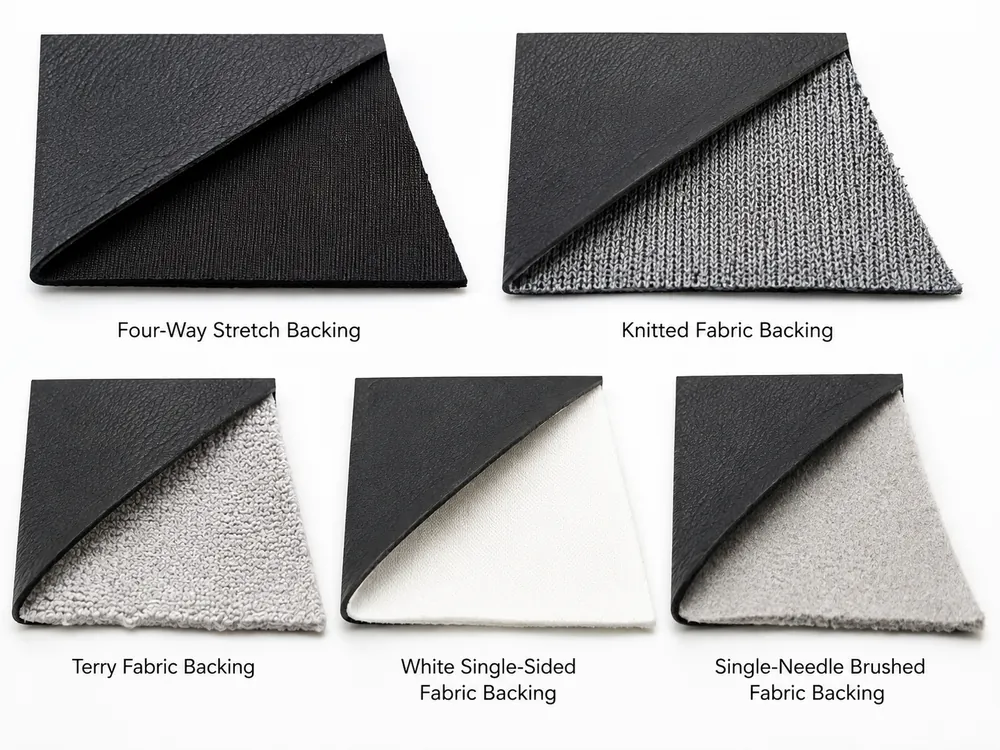
The current Xiangze motorcycle seat range includes several practical backing constructions.
| Backing Type | Main Characteristic | Typical Selection Situation |
|---|---|---|
| Four-Way Stretch Backing | High multidirectional flexibility | Deeply curved and complex seat shapes |
| Knitted Fabric Backing | Flexible textile structure | Curved panels and general motorcycle seats |
| Terry Fabric Backing | Flexible textile support with material body | General motorcycle and scooter seat upholstery |
| White Single-Sided Fabric Backing | Controlled support for selected saddle constructions | General seat panels requiring balanced handling |
| Single-Needle Brushed Fabric Backing | More stable textile support with soft reverse surface | Seat designs requiring controlled stretch |
These descriptions are selection guidelines rather than fixed performance ratings.
Fabric density, thickness and the complete PVC construction still need to be confirmed for each product.
Four-Way Stretch Backing for Complex Seat Shapes
Four-Way Stretch Backing is one of the most useful constructions when motorcycle seat leather needs to conform around complex three-dimensional shapes.
Unlike a relatively stable textile backing, four-way stretch fabric allows movement in multiple directions.
This can be useful around:
- Deep seat curves
- Raised rider sections
- Stepped seats
- Narrow saddle shapes
- Contoured foam
- Rounded seat edges
- Custom motorcycle seats
When the leather is pulled over the seat, multidirectional stretch can help reduce excessive tension at individual points.
This can make the material easier to conform to complicated foam shapes.
However, maximum stretch is not automatically desirable.
If the material stretches too easily, manufacturers can encounter:
- Distorted grain
- Uneven panel dimensions
- Misaligned stitching
- Loss of pattern shape
- Excessive deformation
- Poor recovery after installation
The important property is therefore controlled stretch with good recovery.
For example, XZ73460 Pebble Grain PVC Saddle Leather uses White Four-Way Stretch Backing for motorcycle seat and saddle upholstery.
This type of construction should be tested on the actual seat foam before bulk approval.
Knitted Fabric Backing for Flexible Upholstery
Knitted Fabric Backing is produced from interlocking yarn loops.
This generally allows more flexibility than a highly stable woven construction.
Knitted backing can be useful for:
- Motorcycle seats
- Scooter seats
- Curved seat panels
- Saddle upholstery
- Seat sections requiring moderate stretch
Several Xiangze motorcycle seat products use knitted backing.
This construction can provide a practical balance between flexibility and textile support.
However, knitted fabrics can vary significantly.
A lightweight knitted backing can stretch differently from a dense knitted fabric.
Manufacturers should therefore check:
- Stretch direction
- Stretch percentage
- Recovery
- Fabric density
- Cutting stability
before approving production.
Too much stretch during cutting can cause panels to change shape before they are sewn.
For this reason, the cutting direction should remain consistent throughout production.
Terry Fabric Backing for General Motorcycle Seat Upholstery
Terry Fabric Backing is used extensively in Xiangze’s 0.8mm motorcycle seat leather range.
Its loop-textured textile structure provides support underneath the PVC surface while maintaining enough flexibility for many general motorcycle and scooter seat applications.
It can be considered for:
- Standard motorcycle seats
- Scooter seats
- Saddle covers
- Rider and passenger sections
- Decorative seat panels
Several current Xiangze motorcycle seat products around 0.8mm use Terry Fabric Backing, including decorative stripe, geometric and marble-pattern constructions.
This makes Terry Fabric Backing a useful general-purpose option when the seat does not require extreme multidirectional stretch.
However, not every terry fabric has the same:
- Weight
- Density
- Loop structure
- Thickness
- Stretch
The complete sample should therefore still be tested.
Terry Fabric Backing should not be selected simply because another motorcycle seat product uses the same backing name.
White Single-Sided Fabric Backing
White Single-Sided Fabric Backing is another backing construction used in Xiangze motorcycle seat leather.
It appears in several materials designed specifically for motorcycle seats and saddle upholstery.
Compared with Four-Way Stretch Backing, the purpose is not necessarily to provide maximum multidirectional stretch.
It should instead be evaluated as a more controlled textile-supported construction.
This can be useful when manufacturers need:
- Stable seat panels
- Controlled upholstery tension
- Predictable cutting
- Moderate flexibility
- Consistent sewing behavior
For example, XZ73461 Matte PVC Saddle Leather uses White Single-Sided Fabric Backing.
Other motorcycle seat products in the same group also use this backing with different surface grains and thicknesses.
Because the exact textile density can vary, buyers should confirm the physical sample rather than assuming that all single-sided backing behaves identically.
Single-Needle Brushed Fabric Backing
Single-Needle Brushed Fabric Backing provides a different balance between flexibility and stability.
The brushed reverse surface can add some material body while maintaining flexibility for cutting and sewing.
This construction is used in motorcycle seat products such as:
XZ73447 Smooth PVC Saddle Leather.
A brushed construction may be useful where manufacturers want:
- Controlled stretch
- Textile support
- Stable panel dimensions
- Soft reverse-side handling
- Predictable sewing behavior
Compared with Four-Way Stretch Backing, brushed fabric will normally be selected for a different upholstery requirement.
One is not automatically better than the other.
The correct choice depends on how much the material needs to move around the seat.
Which Backing Is Best for Deeply Curved Seats?
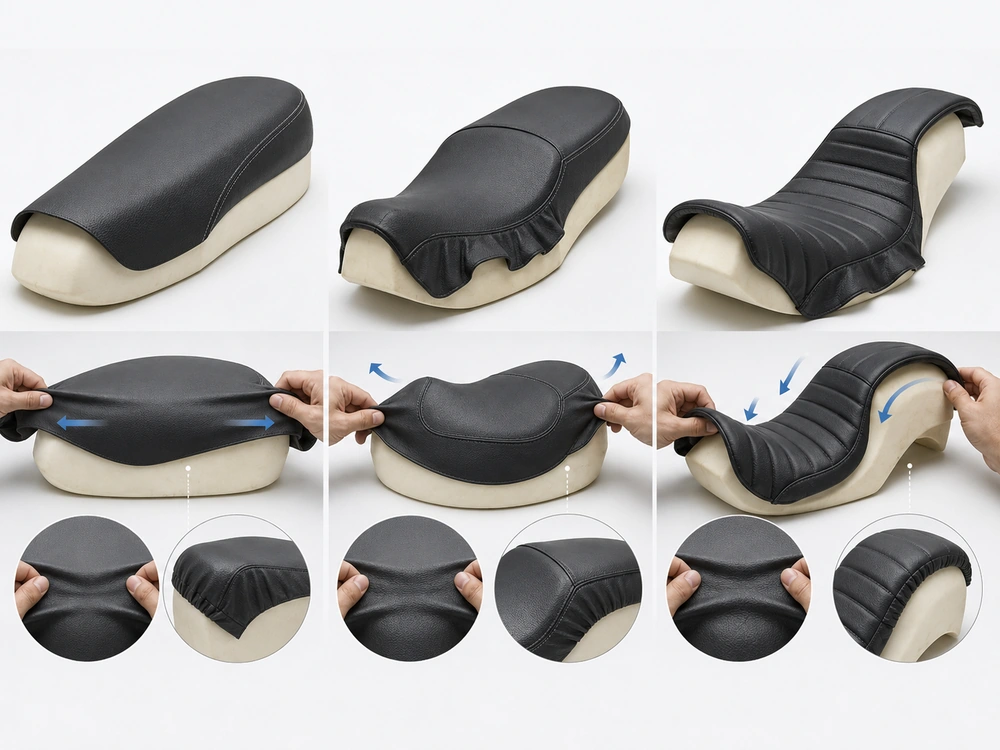
Deeply curved motorcycle seats place greater demands on material flexibility.
Possible problem areas include:
- Raised rear sections
- Narrow front sections
- Deep side curves
- Seat transitions
- Rounded foam edges
For these designs, Four-Way Stretch Backing is often one of the first constructions worth testing.
A flexible knitted construction may also be suitable depending on the amount and direction of stretch required.
The correct choice should be confirmed by fitting the material over the actual seat.
A flat hand-stretch test cannot accurately reproduce the stresses created by a three-dimensional foam shape.
Which Backing Is Best for Standard Motorcycle Seats?
For relatively conventional motorcycle or scooter seat shapes, extreme stretch may not be required.
Useful options can include:
- Terry Fabric Backing
- Knitted Fabric Backing
- White Single-Sided Fabric Backing
- Brushed Fabric Backing
The choice depends on the required balance between flexibility and panel stability.
For example:
Terry Fabric Backing can provide flexible textile support for general upholstery.
Knitted Backing can provide greater conformity around curves.
Single-Sided Fabric Backing can be considered when more controlled handling is preferred.
Brushed Backing can provide more stable support with a softer reverse-side surface.
The best construction should be determined by the factory’s actual seat design and production process.
Stretch Direction Is as Important as Stretch Amount
A common mistake is evaluating only how far a material can stretch.
Direction matters just as much.
A material may stretch significantly across the roll but much less along the roll.
This can influence:
- Cutting orientation
- Panel shape
- Grain direction
- Sewing
- Seat installation
For directional surfaces such as stripes or geometric patterns, manufacturers need to consider both:
surface-pattern direction
and
backing stretch direction
at the same time.
The most visually convenient cutting direction may not always provide the best upholstery behavior.
Sample testing should therefore be performed using the same orientation planned for bulk cutting.
Recovery Matters After Stretching
Motorcycle seat leather is often installed under tension.
The backing needs enough recovery to maintain a clean finished surface.
Poor recovery can result in:
- Permanent stretching
- Loose areas
- Grain distortion
- Wrinkles
- Uneven appearance
A material that stretches easily during installation may initially appear convenient but can create problems if it does not stabilize afterward.
Manufacturers should stretch the sample, release it and observe how well it returns toward its original dimensions.
For complete seat trials, the upholstered material can also be left under tension before final evaluation.
Backing and Sewing Performance
Motorcycle seat covers are often made from multiple stitched panels.
The backing therefore contributes to seam performance.
Important areas include:
- Rider/passenger panel joints
- Decorative inserts
- Side panels
- Piping
- Seat edges
The backing should provide adequate support around needle holes.
A material that feels strong when pulled manually may still tear along a closely spaced stitched line.
Testing should use the actual:
- Needle
- Thread
- Stitch spacing
- Sewing speed
- Number of layers
planned for production.
Different backing constructions may require different machine settings.
Backing and Grain Distortion
Surface grain can change appearance when the backing is stretched.
Fine grains may show relatively subtle deformation, while geometric, stripe and other strongly directional patterns can make distortion easier to see.
Four-Way Stretch Backing is especially useful for conforming around curves, but manufacturers should still check whether the visible pattern remains acceptable after installation.
For directional designs, test the full panel rather than a small strip.
The current Motorcycle Seat Leather collection includes fine grains, pebble grains and decorative embossed patterns with different backing structures, making physical comparison particularly important.
Backing Does Not Determine Outdoor Durability by Itself
Motorcycle seats may be exposed to:
- Sunlight
- Heat
- Rain
- Moisture
- Cold
- Repeated friction
Backing is important for mechanical support, but it does not by itself determine weather resistance.
Outdoor performance also depends on the PVC coating and surface formulation.
If the project requires defined performance for:
- UV resistance
- Light fastness
- Heat aging
- Cold resistance
- Abrasion
- Water resistance
the relevant test requirements should be specified separately.
A Four-Way Stretch Backing does not automatically mean better UV resistance.
Likewise, Terry or Brushed Backing does not automatically make the surface more waterproof.
For the complete motorcycle seat selection process, see How to Choose Leather for Motorcycle Seats.
Backing Does Not Make the Complete Seat Waterproof
PVC leather can have a relatively water-resistant coated surface.
However, the finished motorcycle seat includes:
- Stitching holes
- Seams
- Panel joints
- Edges
- Foam
- Seat-base construction
Water resistance of the complete seat therefore depends on more than the leather backing.
If waterproofing is required, the complete upholstered seat should be tested.
Do not describe a finished seat as waterproof only because the PVC surface resists water.
How to Choose the Right Backing by Seat Shape
A practical starting point is:
| Seat Design | Backing Options Worth Testing |
|---|---|
| Deeply curved custom seat | Four-Way Stretch Backing |
| Contoured motorcycle saddle | Four-Way Stretch or Knitted Backing |
| Standard motorcycle seat | Terry, Knitted or Single-Sided Fabric Backing |
| Scooter seat | Terry or flexible Knitted Backing |
| Relatively flat seat panel | Single-Sided or Brushed Fabric Backing |
| Decorative directional panel | Stable backing with controlled stretch |
This table is not a substitute for sample testing.
The foam shape, seam layout and installation method can change the result.
Compare Backing Samples Side by Side
When choosing between motorcycle seat leathers, use the same evaluation process for every sample.
| Item | What to Confirm |
|---|---|
| Seat Type | Motorcycle, scooter, saddle or custom seat |
| Seat Shape | Flat, curved, stepped or deeply contoured |
| Backing | Exact textile construction |
| Thickness | Complete material thickness |
| Stretch | Direction and amount |
| Recovery | Shape after stretching |
| Flexibility | Ability to follow foam curves |
| Cutting | Dimensional stability |
| Sewing | Stitch-hole and seam performance |
| Grain Stability | Distortion after stretching |
| Wrapping | Behavior around seat edges |
| Surface Performance | Required abrasion and aging tests |
| Width | Effective material width |
| Quantity | Trial and bulk requirement |
The most useful comparison is:
seat shape + backing + stretch + recovery + surface construction
rather than simply asking which backing is strongest.
Test the Material on an Actual Motorcycle Seat
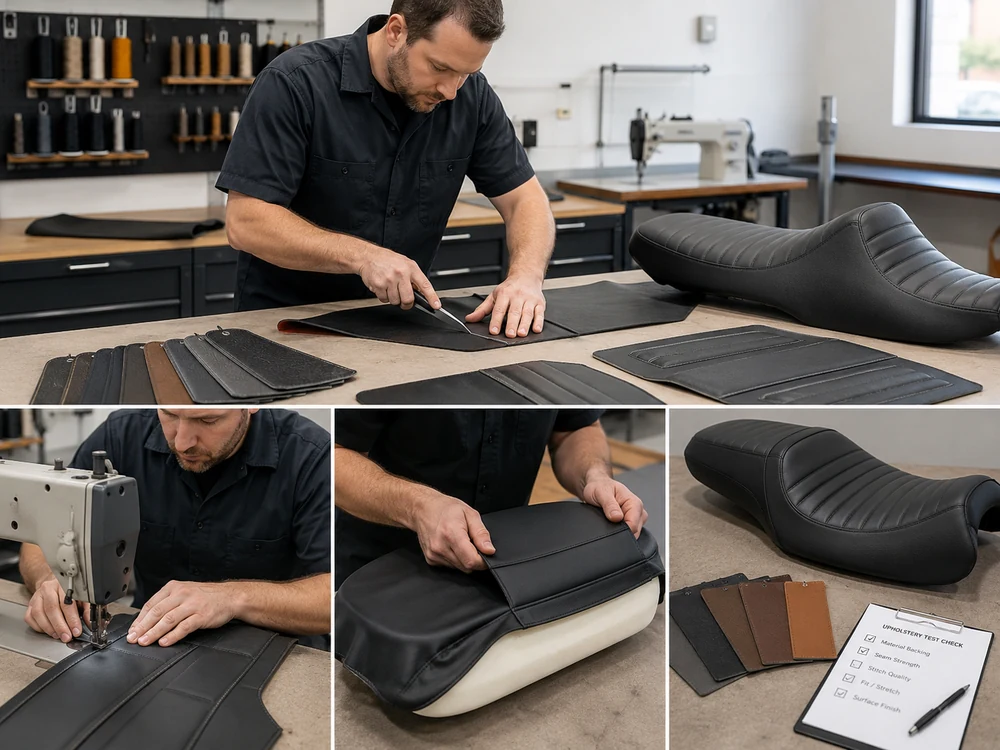
Physical upholstery testing is the most reliable way to confirm the backing.
A useful test process is:
- Cut the material using the production pattern.
- Confirm the stretch direction.
- Sew the actual seat panels.
- Fit the cover over the intended foam.
- Stretch the material around curves.
- Secure the cover using the production method.
- Inspect seams and high-tension areas.
- Check the grain for distortion.
- Leave the cover under tension.
- Evaluate recovery and finished appearance.
This test can reveal differences that are difficult to predict from a small swatch.
For example, a highly flexible backing may work extremely well on one seat shape but provide unnecessary stretch on another.
The correct material is the one that produces the required finished seat with stable processing.
Recommended products
-
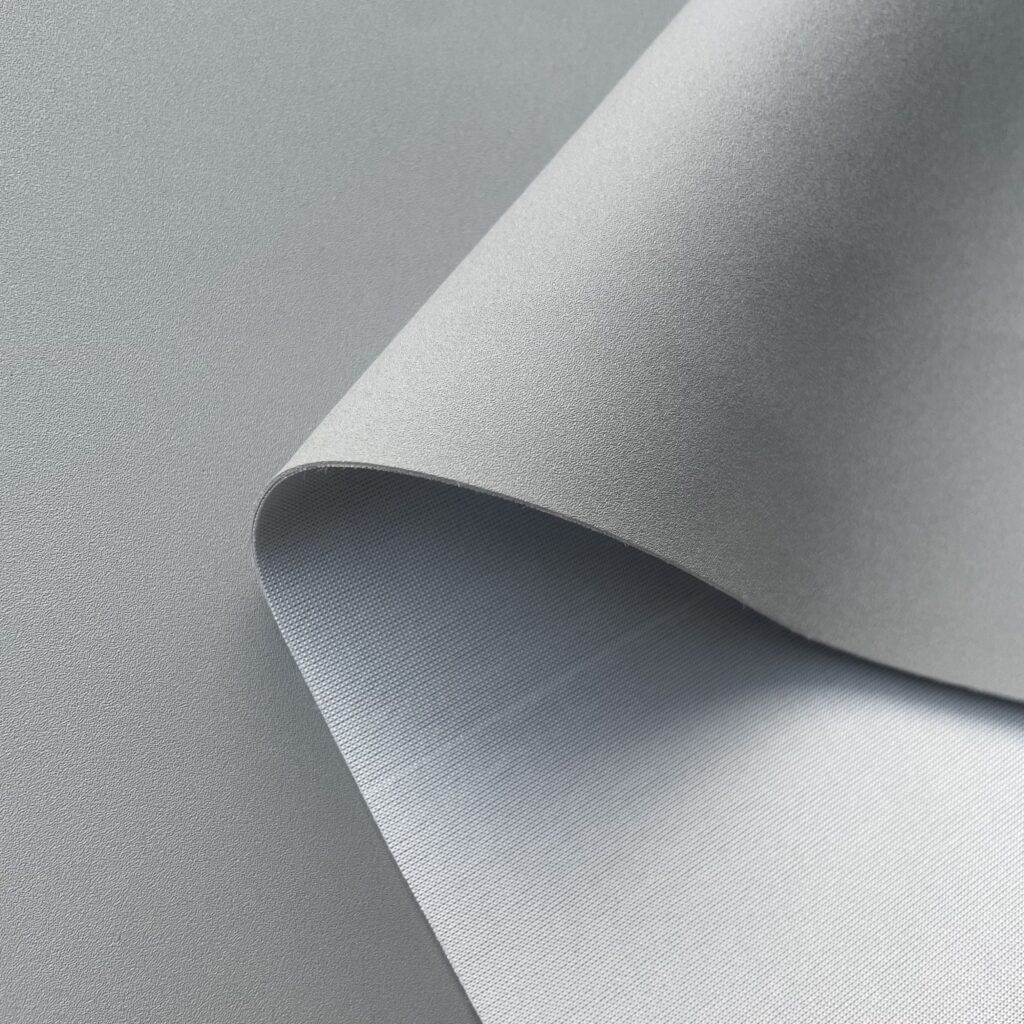
XZ73461 0.8mm Fine Grain PVC Leather for Motorcycle Seats with White Single-Sided Backing
-
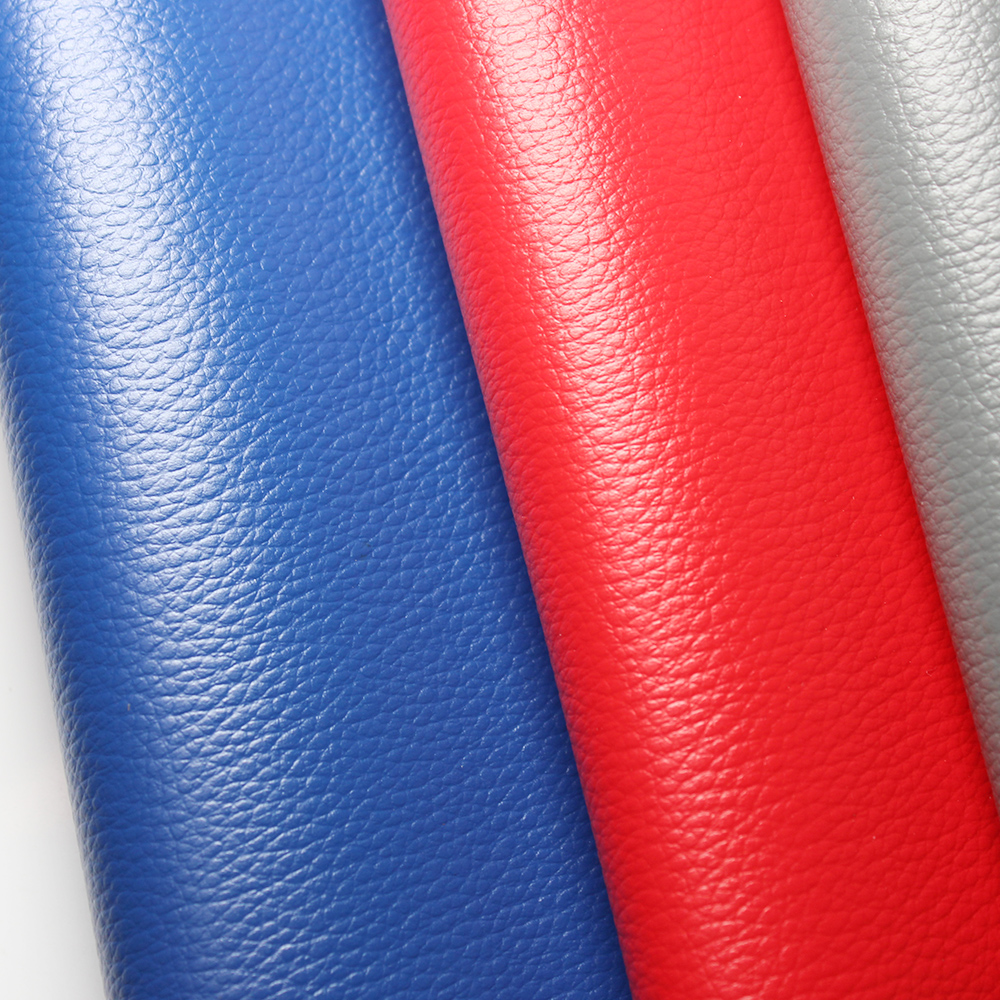
XZ73460 1.2mm Pebble Grain PVC Leather for Motorcycle Seats with Four-Way Stretch Backing
-
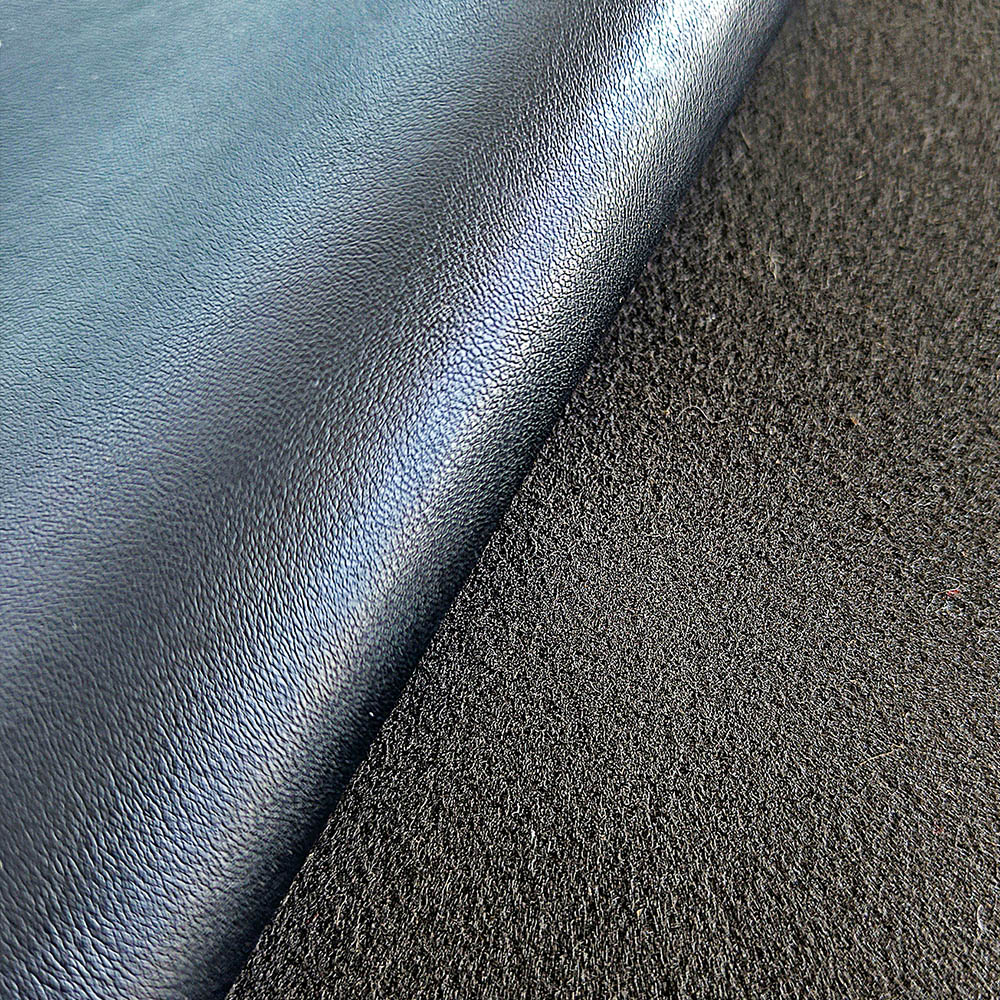
XZ73447 0.9mm Fine Grain PVC Leather for Motorcycle Seats with Brushed Backing
-
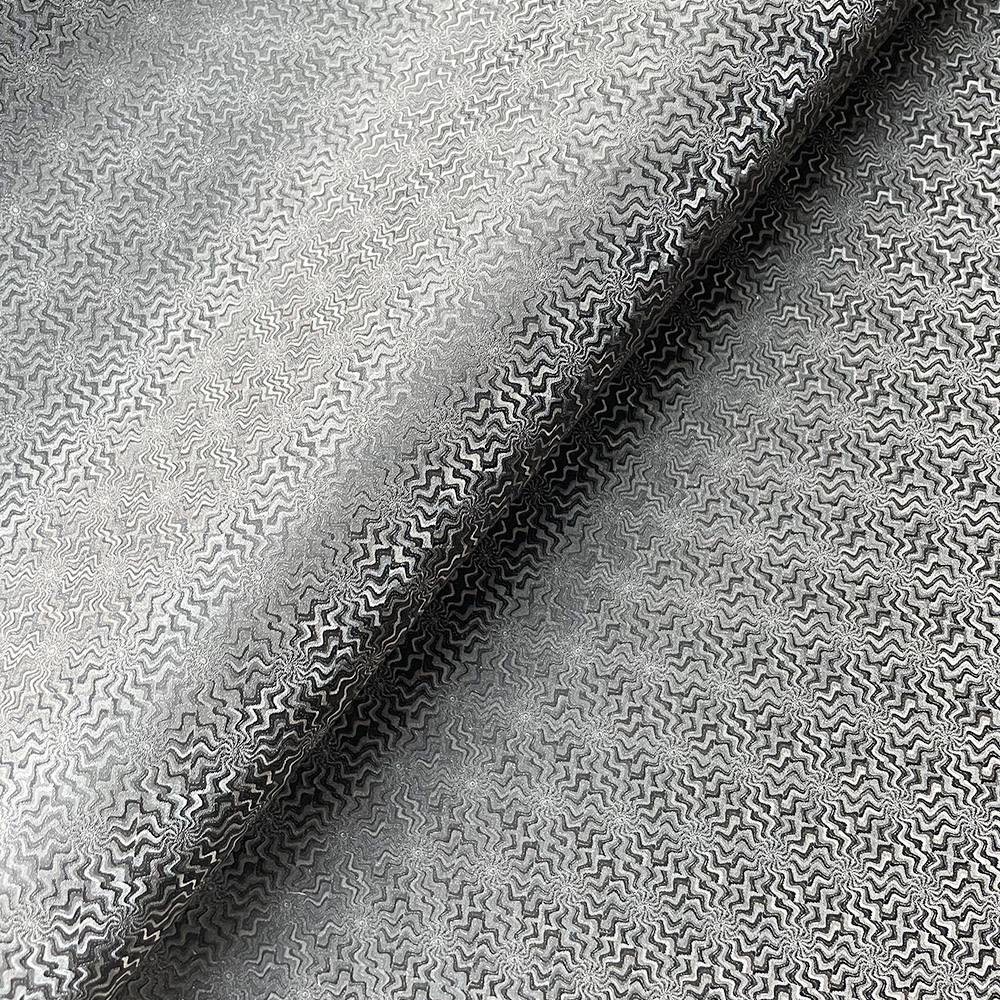
XZ73556 0.8mm Zigzag Embossed PVC Leather for Motorcycle Seats with Terry Backing
Choosing the Best Backing for Your Motorcycle Seat Project
There is no universal best backing material for motorcycle seat leather.
Different constructions solve different upholstery problems.
Four-Way Stretch Backing is particularly useful when multidirectional stretch is required around complex shapes.
Knitted Fabric Backing provides flexible support for curved seat panels.
Terry Fabric Backing is a practical option for many general motorcycle and scooter seat constructions.
White Single-Sided Fabric Backing can provide more controlled textile support for selected saddle designs.
Single-Needle Brushed Fabric Backing can provide stable handling and a different balance of flexibility and material body.
A practical selection process is:
Define the seat shape → estimate the required stretch → compare backing constructions → check stretch direction and recovery → test cutting and sewing → upholster the actual seat → approve the final material.
For a wider comparison of backing structures, see PVC Leather Backing Options.
Xiangze Leather supplies Motorcycle Seat Leather with different backing constructions, surface grains and thicknesses for motorcycle seats, scooter seats and saddle upholstery.
For additional vehicle upholstery materials, buyers can explore the broader Auto & Motorcycle Leather range.
Tell us your seat shape, required thickness, preferred surface, expected stretch, production process and applicable performance standards. We can recommend suitable backing constructions and provide samples for upholstery testing before bulk production.

About Xiangze Leather
Written by Xiangze Leather Editorial Team
Xiangze Leather supplies PVC synthetic leather for furniture upholstery, bags, footwear, automotive interiors, motorcycle seats and decorative applications. Material samples, specification options and quotation support are available according to project requirements.