How to Match PVC Leather from an Existing Material Sample

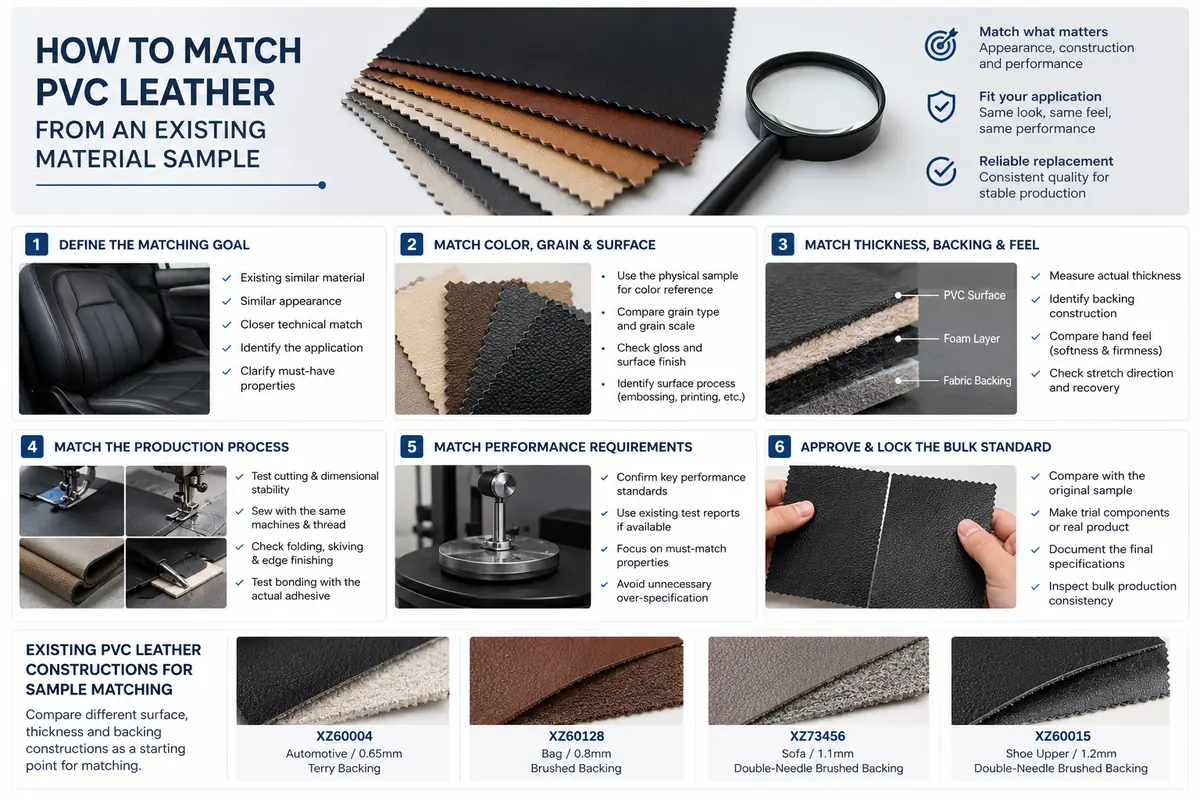
Matching PVC leather from an existing material sample is usually more reliable than trying to describe the required material only with words or photographs.
An existing sample gives the supplier a physical reference for color, surface grain, thickness, backing, hand feel and overall construction.
However, visual similarity alone is not enough.
Two PVC leather materials can look almost identical from the front but behave differently during cutting, sewing, stretching, folding or bonding because their backing and internal construction are different.
For B2B buyers, the objective should therefore be to reproduce the characteristics that actually matter to the finished product rather than simply finding the closest-looking surface.
Xiangze Leather supplies a wide range of PVC Leather Materials with different surface grains, thicknesses and backing constructions for automotive, furniture, bags, footwear and decorative applications.
This guide explains how to use an existing leather sample as a practical reference for material matching and replacement.
Start with the Existing Sample and Define the Matching Goal
Before sending a sample to a PVC leather supplier, determine what needs to be matched.
Not every project requires a completely identical reproduction.
There are generally three possible objectives.
Find an Existing Similar Material
This is usually the fastest option.
The supplier compares your sample with existing production materials and recommends the closest available construction.
This may be suitable when:
- Exact color matching is not required
- A similar grain is acceptable
- Standard thickness can be used
- Existing backing options meet the application
- Faster sampling is more important than exact reproduction
Using an existing construction can also reduce development time and make future repeat orders easier.
Match the Appearance More Closely
Some buyers already have a product design and need replacement material with a similar visual appearance.
In this case, the main matching priorities may include:
- Color
- Grain
- Grain scale
- Gloss
- Surface finish
- Hand feel
The supplier may be able to use an existing base construction while adjusting color or surface appearance.
Develop a Closer Technical Match
For established products, replacement material may need to match not only appearance but also manufacturing behavior.
Important characteristics can include:
- Thickness
- Backing
- Stretch
- Recovery
- Softness
- Dimensional stability
- Sewing behavior
- Folding
- Bonding
- Required performance tests
This is particularly important when a factory is replacing an existing supplier but does not want to change its production process.
The more clearly the matching objective is defined, the easier it is to determine whether an existing product is sufficient or custom development is required.
Provide the Finished Application
Always tell the supplier where the sample is currently used.
For example:
- Car seat
- Motorcycle seat
- Sofa
- Chair
- Handbag
- Backpack
- Wallet
- Shoe upper
- Packaging box
- Table cover
A material that appears similar may still be unsuitable if it was originally developed for a completely different application.
Buyers can compare application-specific constructions through Auto & Motorcycle Leather, Sofa & Upholstery Leather, Bag & Luggage Leather and Footwear & Garment Leather.
Match Color, Grain and Surface Appearance
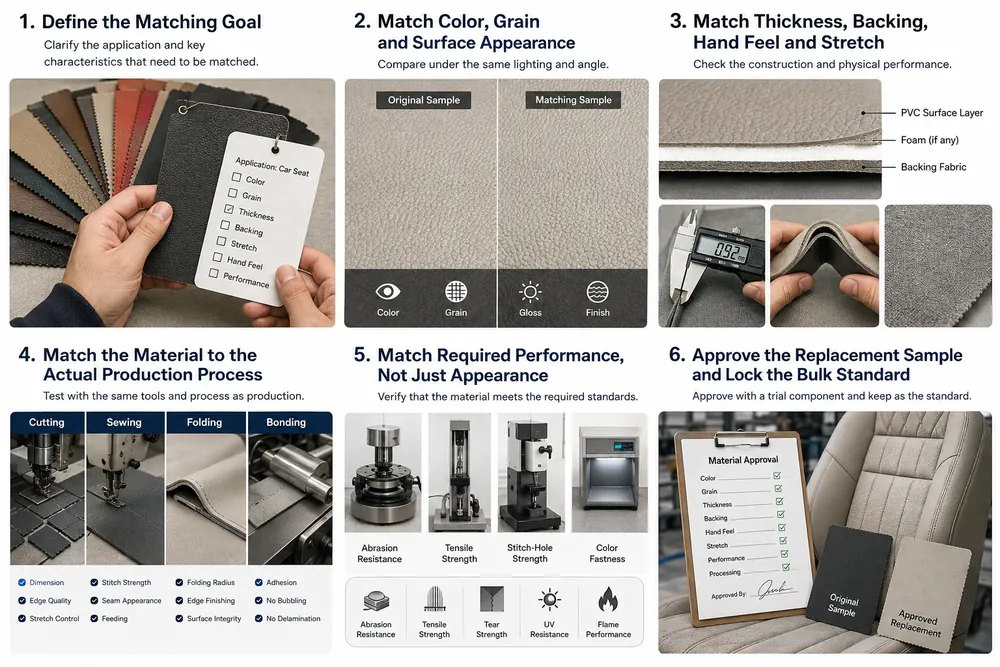
The front surface is normally the first part of the sample buyers want to reproduce.
Color, grain and finish should be evaluated separately.
Match the Color from the Physical Sample
A physical sample is more reliable than a photograph for color matching.
Digital images can be affected by:
- Camera settings
- Screen calibration
- Lighting
- White balance
- Compression
- Reflections
If the existing sample is the approved color standard, clearly tell the supplier that the physical sample should be used as the matching reference.
The sample should ideally represent the original material accurately.
Avoid sending only:
- Heavily faded areas
- Worn corners
- Stained pieces
- Sun-exposed sections
If the material has already been used in a finished product, identify which area represents the original intended color most closely.
Compare Grain Type and Grain Scale
Grain matching involves more than selecting a name such as “pebble grain” or “litchi grain.”
Two pebble patterns can differ significantly in:
- Grain size
- Depth
- Shape
- Repeat
- Randomness
- Direction
A large grain may look correct on a large sofa panel but completely different on a wallet or small shoe component.
When possible, provide a sample large enough to show the representative pattern rather than only a very small corner.
Confirm Surface Finish
The same grain and color can look different when the gloss changes.
Common surface appearances include:
- Matte
- Semi-matte
- Low gloss
- Semi-gloss
- High gloss
- Metallic
- Pearlescent
- Distressed
- Two-tone
Look at the existing material from several angles under consistent lighting.
Special effects such as metallic or pearlescent finishes should not be approved from photographs alone because their appearance can change significantly with viewing angle.
Check Surface Process
If the sample uses a special process, identify it where possible.
Examples include:
- Embossing
- Printing
- Perforation
- Quilting
- Vacuum embossing
- Special decorative finishing
For buyers who want to understand how the visible PVC surface relates to the supporting structure underneath it, see What Is PVC Synthetic Leather?.
Match Thickness, Backing, Hand Feel and Stretch
A good visual match can still fail during production if the construction is different.
This is why the sample should always be inspected from both sides.
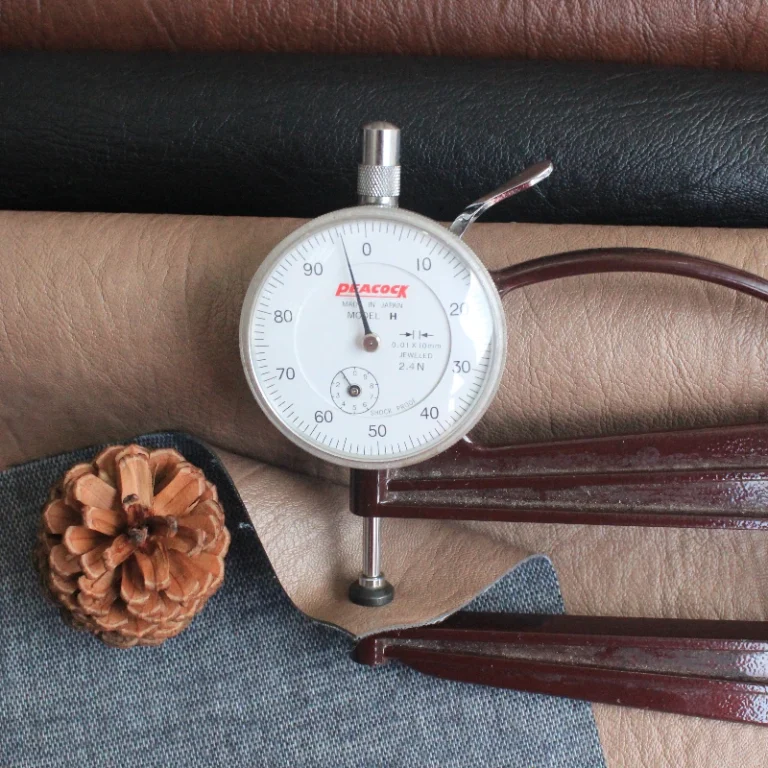
Measure the Actual Thickness
Use a thickness gauge rather than estimating thickness by hand.
Record the measured value and determine whether the replacement material needs:
- The same nominal thickness
- A close acceptable range
- A different thickness because of another backing construction
Thickness should be evaluated together with material body.
Two materials with the same measured thickness can still feel very different.
Identify the Backing
Backing is one of the most important parts of matching an existing PVC leather sample.
Xiangze Leather currently works with backing constructions including:
- Brushed Fabric Backing
- Single-Needle Brushed Fabric Backing
- Double-Needle Brushed Fabric Backing
- Terry Fabric Backing
- Toweling Backing
- Knitted Fabric Backing
- Mesh Fabric Backing
- Stretch Fabric Backing
- Four-Way Stretch Fabric Backing
- Oxford Fabric Backing
- Denim Fabric Backing
- Microfiber Backing
- Spunlace Nonwoven Backing
- Imitation Cotton Fleece Backing
- Recycled Leather Fiber Backing
- Foam Backing
- Other application-specific constructions
The backing can influence:
- Stretch
- Tear behavior
- Material body
- Dimensional stability
- Sewing
- Folding
- Adhesive bonding
A visually identical surface on a different backing may therefore behave like a completely different material in production.
For a detailed comparison, see Common PVC Leather Backing Options.
Compare Hand Feel
Hand feel should be compared with the two samples side by side.
Check:
- Softness
- Firmness
- Flexibility
- Surface touch
- Material body
- Recovery after bending
Terms such as “soft” and “medium-soft” are subjective.
When matching an existing material, the physical original sample is usually a better reference than a written softness description.
Compare Stretch Direction
Stretch the original sample gently in both directions.
Determine whether it has:
- Very low stretch
- Moderate stretch
- Strong stretch in one direction
- Multidirectional stretch
This is especially important for automotive seats, motorcycle saddles, curved furniture and footwear.
A replacement material may have the correct color and thickness but create production problems if the backing stretches differently.
Check Recovery
After stretching the material, release it.
Observe whether it returns toward its original shape.
Poor recovery can cause:
- Loose upholstery
- Wrinkles
- Distorted grain
- Uneven bag panels
- Poor seat-cover fit
For curved seat applications, the matching process should consider both stretch and recovery rather than stretch alone.
Match the Material to the Actual Production Process
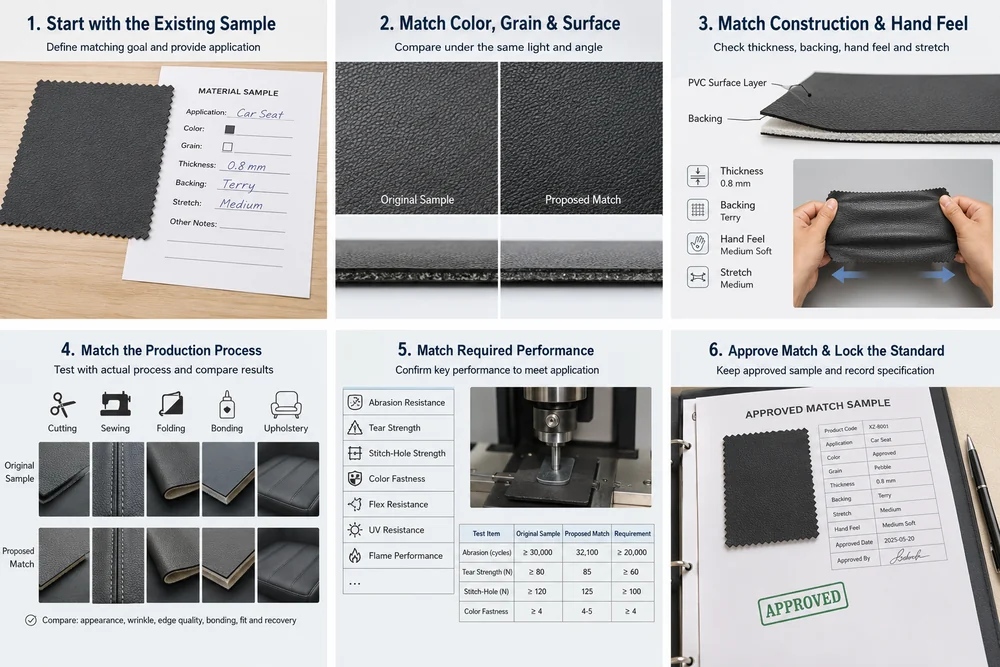
The replacement sample should be tested using the same manufacturing process as the existing material.
This is where many visually successful matches fail.
Cutting and Dimensional Stability
Cut both the existing sample and the proposed replacement using the same pattern.
Compare:
- Cutting accuracy
- Edge quality
- Stretch during cutting
- Panel dimensions
- Pattern direction
- Material curl
A more flexible backing may cause panels to move or stretch during cutting even when the surface looks correct.
Sewing
Use the actual factory:
- Sewing machine
- Needle
- Thread
- Stitch spacing
- Seam construction
Compare:
- Needle penetration
- Stitch-hole strength
- Seam appearance
- Wrinkling
- Material feeding
- Edge tearing
For Bag Leather, also test folded seams, zipper areas and reinforced sections where applicable.
Folding and Edge Finishing
For bags, wallets and packaging, compare:
- Folding radius
- Surface whitening
- Grain deformation
- Skiving
- Edge painting
- Corner formation
A slightly thicker replacement may create much bulkier finished edges even if its flat appearance is almost identical.
Upholstery
For sofa, automotive and motorcycle-seat applications, fit the material onto the actual foam or a representative component.
Compare:
- Wrapping
- Stretch
- Wrinkle formation
- Grain distortion
- Seam alignment
- Recovery
- Stapling behavior
For example, Car Seat Leather and Motorcycle Seat Leather may require very different stretch behavior depending on the seat shape.
Bonding
If the original material is glued to another substrate, use the same production adhesive during the comparison.
Test the replacement with the actual:
- Adhesive
- Substrate
- Application quantity
- Pressure
- Temperature
- Drying conditions
Check for:
- Edge lifting
- Bubbling
- Delamination
- Staining
- Hardening
- Surface deformation
A matching surface does not guarantee matching adhesive performance.
Match Required Performance, Not Just Appearance
When the original material is used in an established product, the replacement should normally meet the performance requirements of that product.
Do not assume that reverse-engineering the thickness and backing automatically reproduces the same durability.
Depending on the application, relevant tests may include:
- Abrasion resistance
- Tear strength
- Tensile strength
- Stitch-hole strength
- Coating adhesion
- Flex resistance
- Color fastness
- Cleaning resistance
- Light fastness
- UV resistance
- Heat aging
- Cold resistance
- Flame performance
- Odor
- Fogging for applicable automotive projects
- Restricted-substance requirements
Use Existing Test Reports if Available
If you have a test report for the original material, send the required values or test standards to the new supplier.
This is much more useful than saying:
“Please make the same quality.”
A physical sample can help reproduce construction and appearance, but it does not reveal every laboratory performance property.
Separate Necessary Properties from Unnecessary Ones
Not every property needs to be copied exactly.
For example, if the original material was developed for a different market and includes requirements your current product does not need, reproducing all of them may increase development complexity or cost unnecessarily.
The better approach is to define:
Must match
Acceptable range
Not critical
for the important properties.
A practical comparison can look like this:
| Item | Matching Priority |
|---|---|
| Color | Must match closely |
| Grain | Must match closely |
| Thickness | Acceptable range |
| Backing | Same or functionally equivalent |
| Hand feel | Close match |
| Stretch | Must suit production |
| Abrasion | Must meet required standard |
| UV | Required only for specified application |
| Flame | Required only when customer standard applies |
| Chemical compliance | Must meet destination-market requirement |
This helps the supplier focus development on the characteristics that matter most.
Approve the Replacement Sample and Lock the Bulk Standard
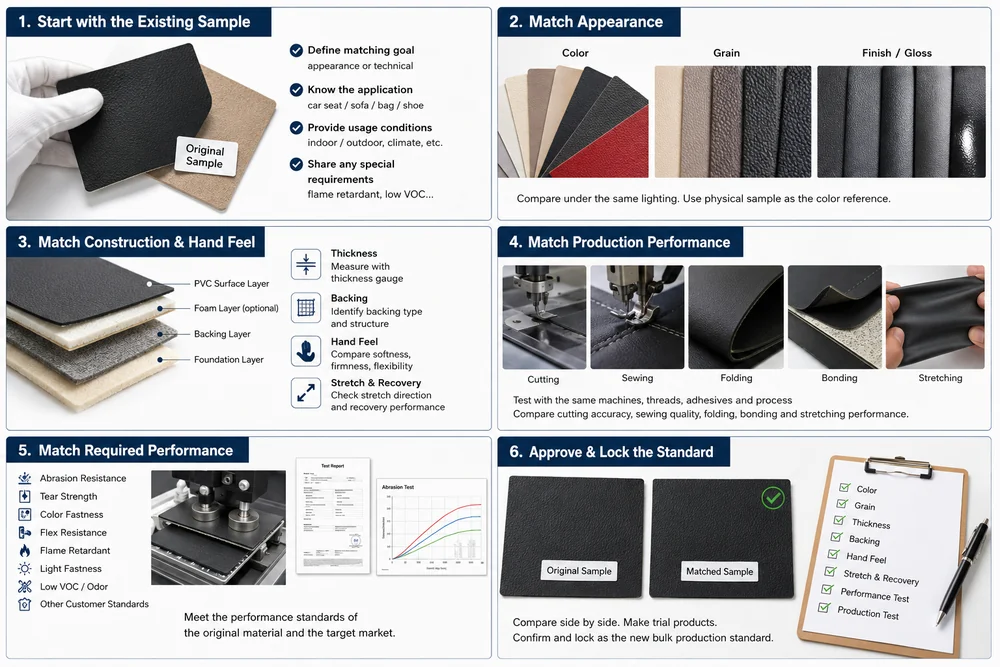
Once a proposed replacement has been developed, compare it directly with the original sample.
Do not approve only from photographs.
Place both materials together and compare:
- Color
- Grain
- Gloss
- Thickness
- Backing
- Hand feel
- Stretch
- Recovery
- Processing behavior
Produce a Trial Component
Whenever possible, use the replacement material to manufacture the actual product or a representative component.
Examples include:
- Car-seat panel
- Motorcycle-seat cover
- Sofa cushion
- Handbag
- Wallet panel
- Shoe upper
- Packaging box
This provides a much more reliable final comparison than inspecting the material flat.
Decide What Becomes the New Standard
After approval, keep the final replacement sample as the new physical production reference.
Record:
| Specification | Final Confirmation |
|---|---|
| Product Code | Supplier material reference |
| Application | Exact finished product |
| Color | Approved physical sample |
| Grain | Approved surface |
| Finish | Approved reference |
| Thickness | Agreed value and tolerance |
| Backing | Exact construction |
| Hand Feel | Approved sample |
| Stretch | Required behavior |
| Performance | Required test standards |
| Width | Effective usable width |
| Approved Sample | Dated physical reference |
The final specification should not simply say:
“Same as customer’s sample.”
That phrase is useful during development but too vague for long-term production control.
Once the replacement has been approved, the agreed construction should be documented clearly.
Compare Bulk Production with the Approved Match
When bulk production begins, compare representative material against the final approved replacement sample.
Check consistency in:
- Color
- Grain
- Gloss
- Thickness
- Backing
- Hand feel
- Surface appearance
Where defined tolerances or performance requirements apply, inspect them according to the agreed purchase specification.
The matching process is complete only when the replacement works visually, technically and during actual production.
Xiangze Leather can compare existing physical samples with current PVC Leather Materials and application-specific constructions.
Send us your existing material sample together with the finished application, estimated quantity and any known specifications or test requirements. We can first check whether a suitable existing material is available and then discuss color, grain or construction development where a closer match is required.
About Xiangze Leather
Written by Xiangze Leather Editorial Team
Xiangze Leather supplies PVC synthetic leather for furniture upholstery, bags, footwear, automotive interiors, motorcycle seats and decorative applications. Material samples, specification options and quotation support are available according to project requirements.